We are furious farmworkers. This text is the final chapter from our forthcoming book: Farmworker fury – Inquiries about organic agriculture. Previous chapters can be found here, here , here, here and here.
In 2020, we read Class Power on Zero Hours by the AngryWorkers. It left us buzzing. After some time of not knowing what to do with our inspiration, we decided to write this book about our work experiences. Leftists often either romanticize (organic) agriculture, or they want it to be fully automated and industrialised. Beyond capitalism, we will have to learn to work the land in a truly sustainable way. Therefore, we think it’s important to have a workers-based analysis of (organic) agriculture. We are writing this book to contribute to such an analysis and we are hoping to receive feedback, comments and critiques from fellow workers and comrades.
The text and PDFs (including footnotes) of the final chapters can be found below…
1. What remains?
This final chapter can only be a rather rough sketch. We simply lack the time and resources to follow every thread we bring up here with thorough research. Still some ideas are ripe to be mentioned. It contains first some conclusions overarching the inquiry chapters and trying to draw lines between the dots and putting it somehow in the wider agricultural, economic, political context in Germany, as this is where we are at the moment.
However we are definitely not the very best (resourced) researchers. Writing after work or in winter breaks with dirt under our fingernails.
So digging out more numbers etc we leave to people with more capacities (comrade-academics and comrade-journalists and of course some liberal NGOs are doing a good job in collecting data, as you can notice in our references). Still we want to share a few remarks and thoughts on some topics, where our opinions might be different to other participants in such debates. And where our dissent stems from our daily experience of horticulture and working class life. We wish this whole book to be a helpful contribution in a conversation among comrades and colleagues who act in the spirit of solidarity.
Workers are writers too!
“If you are silent about your pain, they’ll kill you and say you enjoyed it.”
-Zora Neale Hurston
Writing about our work experiences was helpful to us. The writing was partly healing, partly very challenging. As it took much longer than intended and the texts got much longer and better than ever imagined in advance. The writing helped us making sense of our experiences and sharpen our observation of work and politics. Some ideas only came to us while writing. The online publishing put us in touch with interesting people from around the world. We were invited to a few leftwing events, even internationally. Sorry comrades, we could not make it to every invitation, from Ireland and France to Germany, Poland and Bulgaria. Looking back at writing the texts and publishing them, made our experiences more meaningful, as fellow workers and comrades can access the material and analysis now too. Hopefully it helps in our struggles against oppression.
There is a radical tradition of workers trying to make sense of the world by doing inquiries, which we think is currently mostly lacking in the Left. Beside some cranky Wildcats, Angry Workers, labournet.tv and NotesfromBelow comrades (https://www.angryworkers.org/2021/10/03/the-renaissance-of-operaismo-wildcat/). For a more historical take on the topic tracing militant workers inquiries back to the roots of the workers movements in the 19th century we found Clark McAllister’s book Karl Marx’s Workers’ Inquiry very informative.
For us it is important that we don’t have to rely on the liberal, bourgeois media (although some of it is informative) but collect and share information and experiences from workers to workers first hand. We like being honest about the failures and shortcomings too. We do not need more shiny propaganda words about how this party or that union is going to help us, if we all join and pay our membership fees. And we like to make sense of our experiences ourselves with workers’ take over in mind. We want to make our voice heard. We want to speak for ourselves. We do not need the usual middle class liberal (academics, journalists, social workers, teachers, bureaucrats) to talk about us. We want to be in a direct conversation with comrades and colleagues, writing for each other to put together the bigger picture. Writing is a way of doing so. We wanted to apply theory to our own experiences and let the practice again correct the theory and so on and forth with an non-dogmatic mind towards liberation.
Not all work sucks, though many workplaces do
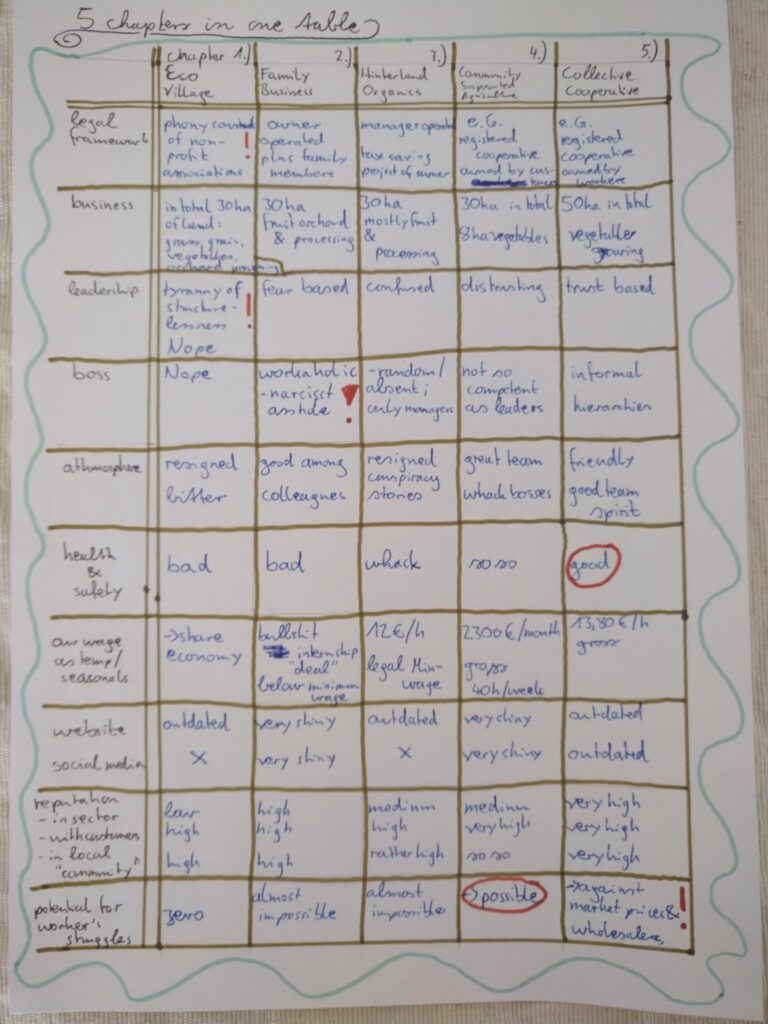
Out of the five workplaces we were writing about, we only found one workplace where we even considered working long-term. But even in the workplaces with bad working conditions and a bad atmosphere, we enjoyed some of the tasks and we have had good times too. You can learn interesting things at work, about vegetables, about people, about machines. We also learned a lot about how to organise certain work flows, social processes, economic calculations and supply chains.
After all we can say there is no good reason to do unpaid ‘internships’ in agriculture to gain experience or to get involved in any informal ‘apprenticeship-deals’ that push you below the legal minimum wage be it as agreements with the boss directly or as wwoofing, volunteering etc. An official formal apprenticeship is a different story.
We got to know fellow workers from Germany, Poland, Portugal, Croatia, Ukraine, Afghanistan, Netherlands, Ghana, Romania, Georgia and Iran. We had great times hanging out with colleagues after work for dinner, barbecues, watching films, dancing or swimming in lakes, sharing hopes, worries and dreams, big and small ones. Overall the working class is as female and “diverse” as never before. And we do not have to travel the world as sabbatical-backpackers to broaden our horizons and to meet workers from everywhere and their stories, getting a job, does the trick too, on a budget. Overall the experienced work conditions branded a clarity in class conciousness in our minds. We usually miss this firm class conciousness when talking to non-working-class leftists or critical intellectuals.
You can live quite well on minimum wage
At least as long as healthy and childless, life is good. We even took longer times off to travel around for hiking or visiting friends. We earned minimum wage or just above it, but because we didn’t pay much rent and got cheap(er) or free food from our workplaces, we managed to save some money and still live good lives. The access to food was very different in our workplaces. Matter of fact the German tax law forbids companies to give anything for free to their employees. Supposedly any freebie has to be treated as additional wage and therefore taxed. Different bosses took this more or less serious and so sometimes we got a lot of produce, which was not fit for sale anymore, still delicious and organic. This way we cut down our own spendings on food a lot. Other workplaces were very strict – but not always looking so closely ;-). Especially in shit places, workers are ingenious about topping up their wages.
Another factor was the daily commute and housing costs. Living on site or in bicycle distance allowed to save more money with the same workload. Of course, living together (as couple or share housing) and being able to share costs, and not having children made this easier for us than it might be for other people. Also, we are healthy and are not putting money into a pension fund or something. But generally we can conclude that if you are interested in getting a job on a farm you do not have to worry too much about not having enough money for the season.
Doing physical work has advantages and disadvantages
During some physical work (the routine, monotonous tasks) your brain is free to think all sorts of things, to dream, to plot, and to plan. And meanwhile observe the boss closely and mentally map out their weak spots. This is in stark contrast to more high-paid white collar jobs we have had, for example working for an NGO, where I felt so absorbed by the job I could hardly think about anything else. However, whenever we had problems with colleagues, felt stressed or not appreciated as workers, the job was certainly able to occupy our brains too. Also, we are constantly doing new tasks and learning new things, which definitely requires a lot of brain power. At the moment, our work mostly makes us feel fit and healthy. When looking at some of our older colleagues, who suffer from all sorts of injuries and whose bodies seem worn out, we are reminded that this might not last forever and that it is important to take proper care of our bodies. Still we wonder if decades of agricultural work are worse than spending decades in an office chair on your physical health and mental health? And we skipped a whole lot of bullshit around pursuing careers in miserable offices and other pretentious bullshit as networking or office politics.
No more time, energy and patience for after-work activism
Because of the full-time, physical work, we had little time and energy or rather patience to do other political work. It is not only a matter of time, but as well of the way in which meetings are done in most leftwing activist groups: There is endless fierce discussions about countless details and very little practical output. I am just tired so let’s get things done, cause it matters! We have to bring back politics and organising to our workplaces (on field). Guess what: While harvesting and weeding – plenty of opportunities pop up all day long, to talk and debate our lifes, politics, wages and plotting to make our fantasies of a better life without oppression come true.
So for after-work meetings to be appealing and relevant to workers, they have to be short and focussed with practical outputs. As well there must be organised child care and a proper meal along with a warm welcoming athmosphere.
It’s about workers’ control
Our conviction that the means of production have to be owned and controlled by the working class were confirmed through our work experiences. Our experiences show that ‘alternative projects’ that are not based on workers’ control, like the eco village and the CSA-project, make a lot of noise (in their area, social media and liberal media). Though we still think they are worth supporting to different extents, they fail to live up to (all) their promises. The decisions about the workplace have to be taken by the workers themselves, they cannot be outsourced to managers or consumers. Put simply a decision turns out differently when those who have to put up with it and do the work have a big say in it. So this is the workers. And this is very fundamental to practical democracy that those affected have a relevant say in the decision making process.
Finding weak points to pressure the bosses
Already after just a few months of working in a workplace, it is possible to find weak spots. To know those is important so the company’s bosses can be pressured to improve working conditions, in case of open conflict. At the CSA project, for example, they did a lot of slick social media marketing, which we thought could also be used against them. As they are very concerned about their good reputation in public. In farms with direct marketing, the farms’ reputation is a weak spot, as they need that image of the good guy the hard working family business and so on in direct contact with their customers. This romanticised image might be challenged if word goes around about poor working conditions and lousy pay…
2. The wider context
The climate catastrophe is everywhere
In our everyday lives as horticulturalists we are confronted with the climate crisis and other environmental destruction on a daily basis. In that season, we saw the damage that drought brings to crops. Increasing water scarcity is already putting pressure on food supply and this will get worse. But the first thing we noticed was the strain the heat and the sun put on our own bodies. We worked in +30°C outside temperatures or 40°C inside the greenhouse. Paradoxically, the climate crisis does not just cause more intense dry periods, but also more storms and heavy rains. So adapting agriculture means to prepare the sector in two opposing directions at once. We have dealt with months of rain and seen the harm it does to crops and the soil (and the concerns about missing incomes as profits and wages). In one workplace we worked with workers who talked about all sorts of conspiracy theories (inquiry no. 3 Hinterland Organics https://www.angryworkers.org/2023/03/27/farmworker-fury-inquiries-about-organic-agriculture-ch-3-hinterland-organics/). But even here we had the impression that workers who work outside every day and have to observe natural processes as a part of their jobs cannot credibly deny the realities of climate change (anymore).
The current situation in Germany
So far, we’ve mentioned some conclusions we’ve drawn based on our work experiences. We think it’s also important to briefly sketch the bigger picture: At the moment we are in Germany so we look at this country. We have to rely on government statistics, so we have to treat these numbers with some caution.
We took this hint by the Angry Workers: “We need more precise analyses of, amongst many other things, the current division and hierarchy of intellectual and manual labour in the essential industries (‘what does the common worker know?’), as well as analyses of actual forms of global supply-chains, agro-industry etc., taking into account the question of potential working class control.” [1]
Agriculture and horticulture
When we tell people about or jobs in agriculture, they often think we work with animals or grain. But horticultural crops such as fruit, vegetables, flowers and ornamental plants are also part of agriculture. They are very labour-intensive and are therefore mostly found on specialist farms. Horticultural crops amounted to 1.4% of the total area used for agriculture in Germany in 2020.
However one hectare of horticultural crops generates several times more monetary value and labour intensity than one hectare of grain or fodder. Still not all farms convert to horticultural high value crops for several reasons:
-path dependencies in how the business is set up: equipment, marketing channels, lack of staff with the specific skills
-vegetables still require a lot of manual work and manual work force
In everyday language the expressions: Farmer, grower, peasant, landworker, farmworker, agriculturalist, horticulturalist are often somehow lumped together. Partially they do overlap, partially they are distinct from each other. We have to keep these inclarities in mind when reading up on the sector. Beside that there are still more distinct job positions in primary production: Orchardists, forestry, shepherds, beekeepers and artisanal food processing as cheesemaking sometimes happens on farm too. As well it is likely to bump into colleagues doing office work or mechanical engineering or IT on farm. Just to name a few and to keep complexities in mind. Agriculture is sometimes an expression used to talk about animal- and grain-farming and sometimes it is intended as an overarching expression including all the distinct branches. All of those general overview data here barely says anything about the specific situation in one workplace or another as our inquiries proof. Average numbers and statistcally summarised data are great for the rough overview and to compare regions or countries with each other. However it does not say much about the actual work conditions in a specific workplace as agricultural businesses differ way more from each other than say one warehouse to another warehouse or hospital to another hospital.
Agricultural workers
Germany has about about 84 million (2022) inhabitants, of which 45.8 million are gainfully employed. Of these 45.8 million, only 555,000 people work in agriculture, fisheries and forestries. (As a comparison: 34.6 million work in the service industry.). There are about 270,000 farms in Germany, employing around one million people and producing goods worth around 59 billion euros a year The number of farms is constantly shrinking. It is only a fraction of the number it used to be even ten or twenty years ago and the tendency is ongoing reduction of number of farms, while the remaining ones cultivate more and more land. In 2020, of these approximately one million workers, 434,000 were employed as family workers. Of the 504,000 non-family workers, 275,000 were seasonal workers, i.e. 55 percent. However this small paragraph already shows how messy the data is, as it puts forestries and fisheries together with on-field agriculture. So this does not allow to point out the exact number of (proletarian) farmworkers in a narrow sense out of the statistics.
Agricultural Incomes
Agricultural workers in Germany work long hours and get paid relatively little for it. In 2018, men working full-time in agriculture, forestry and fishing had the longest working hours of all gainfully employed people in Germany at 49.9 hours per week (women at 45.3). The country’s average full-time working week stood at 41.4 hours. The average gross monthly earnings of a full-time employee amounted to around €4,100 in 2022. Agriculture, forestry, fishing and horticulture is one of the lowest-paid sectors, with a monthly gross salary of €2,609 for a full-time job.
Self-sufficiency
For meat, milk, potatoes, sugar and grain, Germany produces more than it needs itself. But the country cannot cover its own needs for fruit and vegetables. In 2021, the degree of self-sufficiency was 36% for vegetables and only 20% for fruit. The degree of self-sufficiency for tomatoes is less than ten percent: more than 700,000 tons of tomatoes are imported from abroad.
This has a lot to do with competitiveness on international markets and nothing with what is reasonable for people or animal or nature. If we want to safeguard healthy diets for everyone, it will be crucial to establish links to suppliers in other countries while we build up and increase the infrastructure and skilled work force needed to grow the vegetables and fruit we need ourselves. Of course, this raises interesting and difficult questions. Do we need to or want to be entirely self-sufficient? Which food products do we need? Do we keep importing 1.31 million tons of bananas a year from countries like Guatemala, Panama, Costa Rica? What do the banana growers think of this in times of revolt? Eating other things instead of bananas in socialism has been discussed comprehensively by comrades in dissentmagazine. And how this can be much more nourishing and fun than capitalism’s stupid bananas. However this is an old discussion in Marxism. For fellows who love it more abstract: Changing circumstances will create different kinds of subjects and subjectivities. Therefore those subjects may have totally different needs longing to get satisfied, then we do have right now under the current capitalist conditions. Fancy discussion here about what is aneed how does aneed in a subject come into being and is it atrue need orcompensational…Of course all of this is very dialectical and impossible to figure out in detail in theory in advance bla bla bla… PhD paper here, book there, debating club elsewhere… Enjoy. 🙂 Still these are very hands on questions: Which food comes from where? Why? And who is doing that work?
Food production
In 2022, half of Germany’s total land area was used for agriculture. Germany is the fourth largest agricultural producer in the European Union. More than half of the agricultural land, grassland and arable land is used for fodder production. So our vegan comrades definitely have several valid points here regarding a sane use of land. For human consumption, Germany mainly produces meat, bread grain, potatoes, sugar beet, oilseeds (e.g. rape), fruit and vegetables.
Organic agriculture
In 2022, 14.2 percent of German farms were certified organic. 11.2 % of the land used for agriculture is organically farmed. The German government claimed to aim to get this up to 30% by 2030.
Across the EU 9.1% of the utilised agricultural land is cultivated certified organic. Of all EU member states, Austria has the highest percentage of organically farmed land, with 25% in 2020. In 2015, fifteen member states were below 5%, including Ireland, UK, Netherlands, France and Belgium. The aim of the EU is to get the European average up to 25% in 2030.
Subsidies
According to the German federal information center for agriculture, subsidies account for between 41 and 62% of agricultural income, depending on the structure of the main farm.
https://www.landwirtschaft.de/landwirtschaft-verstehen/wie-funktioniert-landwirtschaft-heute/warum-wird-die-landwirtschaft-so-stark-subventioniert As far as we eavesdropped in the workplaces we were working, the subsidies were much smaller – probably because organic fruit and vegetables is a somewhat different business model. The generated value per land unit is several times higher. Meanwhile most subsidies are distributed according to numbers of hectares under cultivation. So the bigger farms get more money than the smaller ones; proportionally as well as in absolute numbers. Agricultural subsidies within the European Union are a very complex topic. We lack the capacity to go into that here properly. However it needs to be investigated properly to understand the sector and its political and economic hardships better. For the European Union agricultural subsidies is the biggest expense in their budget, and the policies on its specific spendings, changed a lot with political fashions over the course of decades. At some time it was a lot about food security, in the context of cold war, at other times it was more about supporting bigger farms and surpressing smaller farms. In other times it was about pressuring or supporting certain technologies or modes of conventional/organic production or capping the use of certain pesticides or herbicides. This issue can easily become a book of its own.
Big vs small workplaces
We have no work experience in big conventional agricultural companies. Still, from what we see and hear around us, we see rough differences between small and big workplaces. Bigger workplaces are generally more clearly structured. They are more professional, impersonal and hierarchical, so there are more workers with common interests, facing very few bosses. In the past few years German media covered numerous scandals about work conditions of seasonal workers in big conventional places not getting their wages, or covid outbreaks in overcrowded accommodation.
In comparison, everyday work on smaller farms is often more improvised and less tied to established routines. In smaller work places, the business side is often much more mixed up with the personal side of life. For example, the owners pay low wages and at the same time expect their employees to deeply love their work and do a lot of overtime (as in chapter 2 on the family business https://www.angryworkers.org/2023/03/02/farmworker-fury-inquiries-about-organic-agriculture-the-family-business-chapter-2/ ). It is common to have retired (grand-)parents or relatives helping out on the farm (even unpaid). It is also a widespread practice for apprentices to live on site and share facilities with the business and/or owner and their family, so at least some workers are half-adopted into the family(-business). On top of that, the self-exploitation of many farm-owners is enormous, so it is difficult to approach that context with a traditional leftist capital vs. labour analysis only. Farm owners are obviously exploiters of surplus in the current economic structure. At the same time they are under massive market pressures themselves. Matter of fact within the food industry, the biggest capital and capital’s power lies in wholesale, food retail and with food processors like dairy plants or industrial butchers. Capital simply leaves its hands of the risky business of actually growing food to farmers/growers but controls prices by controling the whole food processing and food logistics chain.
Many leftists and ecologists have a lot of romantic images of small-scale peasant work. Personally, I think these people live in a very urban bubble and have not done enough weeding, as the everyday experience of workers on small farms is often tough. However, we have also visited small farms that are actually economically profitable, with better wages and overall better working conditions for owner and workers. In our experience, it has a lot to do with doing proper business planning and calculations on the side of the owner, on top of being skilled agriculturalists/horticulturalists. Really thinking through every little detail in work processes does make the difference in the end if profits are made or not, if it is endless toiling or decent work, if the atmosphere is good or bad.
Mental health and social dynamics matter
In many countries, research shows that suicide rates are much higher among farmers than among general members of the population. In the US, the suicide rate for farmers is more than double that of veterans of war. In Germany, research suggests that 4.5 times as many farmers are affected by burnout than members of the general population. The rate of depression among farmers is three times higher than in the general population.
The differences we observed between companies were not entirely structural, but were also related to social dynamics and the mental health of the owners and/or workers. Even though structurally, it changes very little, it does make a difference to our everyday lives if the boss is a polite, reasonable person or a dickhead (erratic, yelling, tricking with wages, moody..) . In the cooperative (chap. 5 https://www.angryworkers.org/2025/12/05/farmworker-fury-inquiries-about-organic-agriculture-ch-5-the-collective-cooperative/), we felt trusted and respected, and our ideas were generally welcomed and taken seriously. In the CSA project (chap. 4 https://www.angryworkers.org/2023/08/02/farmworker-fury-inquiries-about-organic-agriculture-ch-4-a-community-supported-agriculture-project/), the bosses did not welcome our suggestions (sharp knives, rainjackets…) at all, which was frustrating. In all workplaces, the work pressure in the high season was very high (over time is regular, weather etc.). Troubles with mental health seem to be so wide spread, that we have to essentially figure out comradely collective working class approaches on mental health to deal with it not just individually but as a political movement.
Health and safety
We learnt that health and safety is always a hot topic. Of course, minimum requirements exist by law. Someone might have heard of some authority fairy in a far away bureaucracy forest who enforces those standards with a magic wand, but in reality it is us workers enforcing and implementing safe(r) work conditions, or nothing happens at all. Guess what; as the inquiries proof, asking nicely or pointing out official regulations in a polite conversation with the bosses is not helpful in this regard. It is simply not the interest of the business/boss to spend more money than is absolutely necessary. This is contrary to workers’ interests to stay healthy and sane while working.
No surprise on gender issues
In Germany, around 36% of all agricultural workers are female. We think this number might be higher in organic companies. Still, in most workplaces, we saw a very “traditional” role division: generally, more men were in charge of machines like tractors, chainsaws, and welding equipment, and more women were in charge of the social side of the business and household tasks like cooking and cleaning, paper work and (informal) conflict mediation. We perceived the women’s work often to be less visible on first sight.
Around 22% of women working in agriculture are permanently employed, 35% are seasonal workers. The proportion of family workers is 43%. The majority of these female family workers are spouses (59%). Female business owners make up only 18% of the female family workers. We have only been told of the ELAN-network, they sound interesting but we do not know how strong or active they are. They seem to be at the threshold of agriculture and queer-feminism. All the data we found only worked with binary gender definitions.
Some thoughts on vegan agriculture
As we describe in inquiry number 5, most (organic) horticulture relies on a steady input of animal products, such as hog hair pellet fertiliser. Some liberal-leftist NGO’s as well as animal rights activists and climate activists see veganism, including vegan agriculture, as one way out of the climate crisis. We think reducing our consumption of animal products makes a lot of sense when looking at the land use and environmental impact of animal farming. But we do not have a strong opinion about a 100% vegan agriculture. We think it is best to look at what approach fits best for specific ecosystems, in stead of propagating veganism as the most ethical approach in all circumstances. For example, compost and mulch materials have to come from somewhere and be transported, so they are not always good alternatives to animal manure. However we are not going into this discussion here. Among leftists this is one of the most annoying and most fierce but fruitless discussions ever. As far as we understand the climate catastrophe has a lot to do with burning coal, oil and gas and the usage of petroleum based products. So this must stop first. And yes of course there is a lot of lobby bullshit thrown into media and science, which makes it hard to get proper information on it. However we are not convinced by people arguing “100% vegan and nothing else!”. As this usually comes from urban upper class liberals. However a strong reduction of animal farming does make sense to us. A rule of thump may to have only as many animals on site, as the farmland can feed. In temperate climates this is roughly one adult cow (or equivalent) per hectare of grassland. This should reduce animal farming a lot and make big international food imports (soy from Brazil to Europe…) unnecessary.
It does not make sense to us to insult animal farmers on so claimed moral high grounds. And beside all the meat industry money we would like to know where the vegan team gets their money from? Matter of fact we wish to have proper conversations on this in the spirit of solidarity among comrades and fellow workers. We wish to encounter as much empathy and practical solidarity with working class people of all genders, races, ethnicities and identities as the animals receive from political veganism.
However we definitely agree on the aim of reducing suffering for all beings. We wish this conversation to be held in a goodwilling debating culture among comrades. By the way if you do not care about capitalism and patriarchy we do not care about your stuff at all.
We need to link up with other workers
We noticed that the conditions from one agricultural company to another differ much more than in other industries, like from one factory to another factory. This makes it harder for workers to see their common interests and join forces. Also, agricultural workplaces have no (great) history of industrial action and are generally poorly unionised. Notes from below comrades dug deep into the history of landworker struggles in the UK. The most recent incidents they came up with were big strikes and riots in 1830, 1872 and 1923. More than 100 years ago! Anyways their book on the topic is a great read and feels like a sibling to this little furious farmworker book.
As in other sectors, workers are disillusioned and have little faith in their ability to change things. It is therefore very hard to imagine any kind of revolution starting in agriculture. The “farmers” protests in many European countries in winter 2023/24 often have had to different extents far right-wing or conspiracist flavours. However this was almost never farmworkers but rather farmowners and random right wingers. While the Left was mostly absent from this. It is worth to mention the exceptional interventions here of the small anarchosyndicalist German union FAU section Grüne Gewerke and AbL (Arbeitsgemeinschaft bäuerliche Landwirtschaft – the German sibling of the international peasant organisation Via Campesina). As far as we know, we never met anyone at work, for whom any kind of trade union was a relevant point of reference in the 2020s. So from our side solidarity and love to the FAU for seriously trying to get a class based organising started in the sector. It is overdue and no one else will do it, if not ourselves. The AbL is still worth mentioning. It seems to be a small but rather noisy organisation, from my view it is limited in its potential as it is a cross class organisation, trying to include mostly farm owners and all sorts of people who in different ways “identify” themselves with agriculture in a broad sense. Anyways we respect their ardent continous work and enjoy reading their monthly newspaper Unabhängige Bauernstimme (https://www.bauernstimme.de/home). For sure it opens up space for relevant conversations on agriculture. For example on genetically modified organisms GMOs.
Even though landworkers are unlikely to be at the forefront of the next revolution for all the structural issues described in this book. Whoever starts the revolution will need to establish links to farms, or rather the farms’ workforce immediately. In case of a workers’ takeover, workers in food production will have to coordinate closely with workers in food logistics, food processing, food retail, as well as with food workers in different countries. We have to start establishing these links now.
3. Uprising
More leftists need blue-collar jobs!
It is striking that very few leftists work in practical or manual professions. We learned a lot from our work on farms. It is very important more leftists get to know the world of blue-collar jobs and workers. Many of the advantages to working on farms we mention are not universally valid and working on farms is not realistic for all people. But we think there is a strong case for doing blue-collar jobs for many more leftists. Why hang around university or NGOs and compete with each other for lousy precarious temporary jobs and overpriced share apartments in gentrifying cities? We think (subcultural/scenester) leftists are often tempted to start a career as a critical intellectual where a lot of people are competing against each other. Ultimately, the critical articles, PhD papers, blogs and books those people are writing do not change anything. We have done our part to it too. If we are serious about workers’ politics, we have to be blue collar workers ourselves. There is a shortage of skilled workers throughout most industries in Western Europe. We can work almost anywhere, and many practical jobs (and the knowledge that comes with it) are very strategic.
Of course there is useful strategic job opportunities in all sorts of academically trained jobs too: Engineers, doctors, teachers and lawyers are just a few examples of skillsets, useful for working class movements. If taken on by comrades with sound politics, who know which side they are on. Still historical evidence so far suggests that those job groups have rarely taken the, lead in fighting against oppression and for emancipation. The saying that we should “be the change we want to see in the world” is nonsense. Big capitalist corporations will not stop destroying the planet just because we change our lifestyles or set up small “utopian” projects. They will stop doing this only by force, and we can get force by organising together in solidarity and dedication. And because capitalism relies on our labour, we have most power in the workplace. Strike, sabotage and take over workplaces to make them useful for people not capital. Of course that is a long way, and stupid saying alert, it starts with first steps as small as talking to colleagues and getting to know each other and establish small improvements in the workplace.
We need people who do jobs and have (or gain) knowledge and skills that is useful after capitalism. Not just people who work for NGOs and charityclubs that are trying to save the world. Stop living off the problem, by only talking about it. Get a blue-collar job! Or at least several internships or summer jobs.
With at least a little sense for observation this helps to understand and make sense of the world in direct confrontation with it, not from text or media. It definitely helps to take notes every day after work and to find at least one friend to team up with for such antics. This is how this book came into being :-).
Those corporations which are destroying the planet and peoples lives, are doing so, because that is how they make money. Shell, EXXON, Tesla, Amazon, facebook… just to name a few, are not going to stop doing so. Because some (paid) NGO-worker is “raising awareness” in the public sphere or liberal media. Nothing wrong with explaining why destruction and oppression are bad for moral reasons. Capitalism simply gives a shit on your awareness crusade. And whoever is the government for the moment gives a shit too. Accumulation of capital or put simply just making money goes on. For example if more people in Germany transition to eating vegetarian/vegan, the German meat industry (like Tönnies) simply increases exports to China. By the way Tönnies is doing an organic business branch too now, still does not change anything to us… So there is good reasons for certain diets over other diets that is for sure, however the change they cause might be smaller than many liberals and marketing people are trying to make us believe. For us it is a diet not an identity.
You are part of the „system“ anyways
There is no “outside the system” as some alternative hippies, or eco bourgeois start up hipsters (or the Eco Village and CSA people mentioned in chapter 1 and chapter 4 (with fancy consumption habits) still pretend. Although we are doing an essential and inherently useful work in food production.
Let’s see how the current economic relations work
I do wage work producing vegetables as a horticulturalist. This way I generate profit for the farm. The produce is sold. And part of the money is paid to me as a wage. The other part remains in the company as surplus.
Even though I might pursue some eco/ethical consumption habits. We are doing so matter of fact, without feeling superior to people who do differently and without exaggerating its impact. The majority of my monthly spendings goes into paying rent. So it ends up in the landlord’s pocket. And I have to pay some taxes to the state and costs for health insurance and so forth. Where does the farm’s surplus go? Even though it might be a small scale super utopian ambitious project: The biggest share of their investments goes into rent → landlords or fuel, machinery, equipment, seeds… guess what? Most of it is controlled by big corporations, making money in the current capitalist conditions. So instead of trying “tactics” that do not work since decades like consumer choice or being the change you want to see in the world… Let’s rather pull together all our hope, dedication and dreams and get serious.
Towards a workers’ takeover – Don’t you know they are talking about a revolution
For us, even daring to think and talk revolution seems very abstract and far away. And even comrades sometimes admit they find it scary. Personally I find the status quo way more scary. However, we strongly believe that revolution is where we have to start! We do not know what a path to a revolutionary takeover looks like either, and this is not something two people and a bunch of their comrade-friends can figure out. But we firmly believe that the first step is to even dare to imagine a revolutionary workers’ uprising practically. The Angry Workers have already done a great job here. We want to share some first thoughts specifically about how uprisings will affect agricultural workers, and we are curious about other workers’ ideas on this.
In case of an insurgency, farms will be faced with (international) supply chain issues. These problems will hit certified organic places roughly as much as conventional farms. The organic ones overall have smaller shares of external inputs. But they are far from self-sufficient. The vast majority of farms still operate conventionally. They are heavily reliant on external inputs such as fossil fuel-based fertilisers, fuel and pesticides or additionally bought fodder etc. Even though organic farms are not dependent on fossil fuel based pesticides, they are generally more reliant on fuel for vehicles than conventional farms. In a transitional phase, we will still depend on these inputs and will have to safeguard their supply. Then, we will have to put a lot of effort into transitioning the agricultural sector to at least organic standards. As this is less energy intense and environmentally less harmful.
This means that, as revolutionary farmworkers, we need to start establishing links to workers in companies that produce fertilisers, machines, beneficial insects, IT systems for GPS tractors, spare parts for tractors, irrigation systems, greenhouses, solar panels etc. We also need to start establishing links to agricultural workers and suppliers in other countries. We need to learn from historical examples about huge-scale transitions to a more a sustainable agricultural sector. We need to study truly sustainable agricultural practices all over the world and try them out on a big scale. This realm travels under many different names, but beware some of the actual doings under those labels by different agents are just greenwashing or bollocks: Sustainable, agroecology, agroforestry, permaculture, regenerative, organic… just to name a few. And of course we must be honest about successes, failures and mixed results in historical case studies
Just to drop a few buzzwords: Agriculture in the Soviet Union in the 20th century, transition in Cuba in the 1990ies, countless examples of ancient and/or indigenous practices all over the world and how they got destroyed or pushed underground by colonialism. However resistant people preserved a whole lot of skills and knowledge all around the world regarding specific local contexts.
After an urban workers’ uprising, an important question will be: who is going to challenge the property relations in the rural areas and how will this happen? We guess a lot will depend on the particular social dynamics and social ties in the local town. For example, in one of the companies we worked for, the landlord-family who owns the land and farm will probably be the main problem. This family (one of them is an active member in the local Green party) runs their own conventional farm, next door to the organic company. And they will still want to get rent. In another workplace the boss was a conservative party member of the town’s council with many contacts to other local shopkeepers.
What can we do right now?
In our experience, there is no blueprint of a workplace that presents the ultimate answer to all the ecological and social issues of the current capitalist-industrial food system. A practical policy change we can demand right now is improving the working conditions of agricultural workers: Having proper health and safety equipment, being paid on time and correctly (Yes it is that bad – no surprise revolution sounds impossible), less heavy lifting, sufficient sun screen and hats for free etc.
In Germany, this would entail enforcing the minimum wage for seasonal workers without exceptions and minimum legal requirements on working hours, sick leave, health and safety …
Another interesting policy demand might be an implementation of certified-EU-organic-standards on all farms. This would imply big programmes of training and preparation for the farmers and farmworkers and there needs to be a market for it, beyond the price dumping supermarkets and discounters, otherwise smaller and middle-sized agriculturalists will simply go bankrupt.
It is in all workers’ interests not to have to work with toxic substances (pesticide spraying etc), so it might be a very hands-on and practical stepping stone to reduce usage of toxic substances enormously in comparison to contemporary conventional practices. All landworkers in all conditions and countries will have a common point of reference in staying healthy and not getting exposed to pesticides. This might be a popular reform demand many workers and comrades can support for their own advantage. On top of that, consumers, liberal allies, environmentalists and green parties can probably agree on it too. Beside that sometimes the EU has funny policy ideas about capping pesticide use.
We have to talk about agriculture’s reliance on fossil fuels (and energy input in general: fuels, heating, diesel, fertilisers, seeds…). This topic has become more prominent in the mass media since the war in Ukraine started in 2022.
Organic is not a luxury but only reasonable
In organic food, we are partially paying for costs that are externalised in conventional agriculture. Externalised – is just a capitalist or economist euphemism, for making someone else pay to raise the own profit margin. In the mid-to-long-term, a lot of us workers will be paying for those externalised costs with our health and money (for example in the form of taxes). Stressing this point could be a way of making organic food and organic production more appealing to a broader public. We have no idea how much government bureaucracy is busy with monitoring nitrate remnants from fertilisers in ground water. Even the official horticultural apprentice training book admits, that there is rarely any knowledge on the long term impacts of pesticides and herbicides on humans or the environment. Maybe because the results would be to inconvenient.
We are not going to leave healthy organic food to hippies, new age yogis and rich consumers. Who is growing the food? Who is working the land? To whom does it belong? The landlords or the workers?
Finally, we want to recommend two more texts which have a lot to say on the close relations between society and nature rooted in decent workers’ communist aspirations: We found both of them helpful in the writing process of this book, although we are not quoting them directly. They help seeing the bigger picture: The Habitable Earth: biodiversity, society and rewilding published in 2021 by Ian Rappel. And less optimistic The Tragedy of the Worker by the Salvage Collective.
“Don’t you know, they are talking about revolution”
Tracy Chapman was right. And don’t you get the irony when this song is played in the radio while doing grocery shopping in a random supermarket? It just provokes to start looting that shop. What else should we be doing. Giving in? Giving up? Keep trying.
But when the loot is eaten up, so after two to three days, we are going to need skilled workers growing food all over the country. If you love this world or „nature“ or care about your children. Let us invite you to take yourself and your feelings even more serious and join us in doing something about it.
Looking forward to see you on the fields, at the union meetings, in the countless conversations and infinite attempts to get ourselves organised. You are most welcome. Sorry there is no shortcut and nobody else is going to do it. We need class based organisation and movements within the agricultural sector and in society at large. Without uncompromising class politics we are not getting anywhere, neither in the workplace nor after work.
Love and Solidarity to all fellow comrades, colleagues and friends, never walk alone