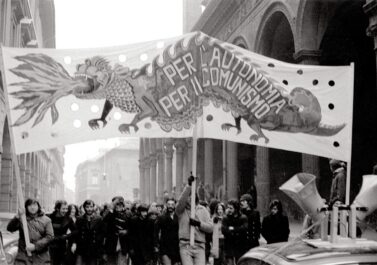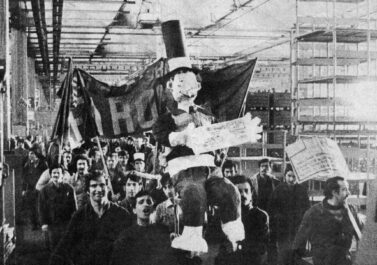
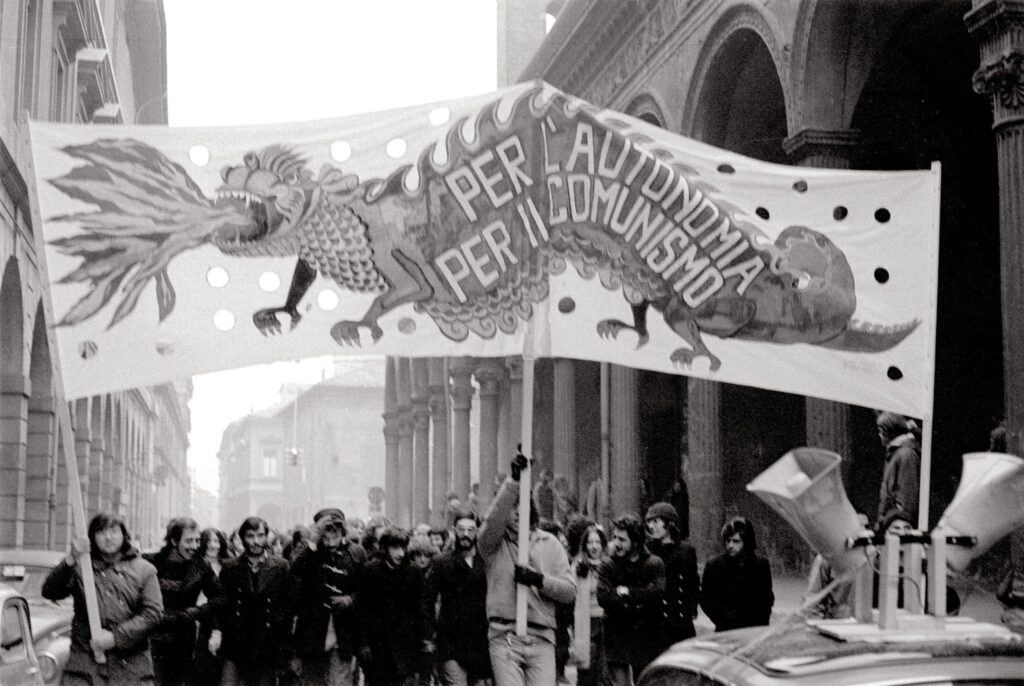
In the first part of this series we could read about the conflictual relationship between the main national extra-parliamentary groups of the far-left in Italy in the 1970s, such as Lotta Continua and Potere Operaio, and the political organisms of workers autonomy.
In the second part we documented translations of two political proposals by three of the main autonomous worker organisations: the Autonomous Assembly at Alfa Romeo and Pirelli and the struggle committee at Sit-Siemens, mainly located in Milan.
In this part we provide a translation of an organisational proposal by the CAO (Autonomous Workers Committees) from Rome, circulated in 1978. We think the material of this series is still relevant for our quest for a new form of working class organisation today.
*** Intro
The proposal by the comrades in Rome reads somewhat abstract, focussing a lot on the relation between autonomous mass organisations (‘soviets’) and political organisations (‘party’), between ‘counterpower’ and ‘direct democracy’.
“By counter-power we mean the permanent overturning of power, the removal of the organs of domination achieved through the spread, rooting and mobility of the revolutionary presence, through the hegemony of a section of the class within the class composition.”
“It will then be in the phase of the dictatorship of the proletariat that the structure of proletarian self-determination will tend to take on a prominent role in the Soviet-party dialectic, leading to the extinction of the party, collateral to the extinction of the state.”
The abstract nature is surprising, in particular giving the wealth of concrete experience the comrades from CAO had. They were organised and dominated the workers’ struggles in the main hospital of Rome, the energy corporation ENEL, but also in telecommunication, the railways and some of the local factories. They organised the self-reduction of energy prices, mass housing occupations, started the anti-nuclear power protests in Italy, founded one of the first radical radio stations and formed the organised core of the student movement in 1977. Below, before their organisational proposal, we added some passages from ‘Volsci – the Autonomous Workers Committees in Rome in the 1970s (1971 – 1980)’, by Salvatore Corasaniti in order to illustrate the rich organisational background of CAO.
Given their specific local class composition in Rome, which was less based on bigger industrial workplaces, the comrades focused their political proposals on the ‘territory’. During the efforts of building a national coordination during 1973/74 this clashed with the perspective of autonomous workers committees in Milan (see second part of this series), who maintained that the workplace is not only where the organic working class power is situated, but also the guarantee for political independence of workers’ organisations. The comrades in Milan, and other industrial areas, saw the danger that with a focus on the ‘territory’, the role of ‘the organisation’, as a structure that holds a less cohesive ‘territory’ together, would again detach from actual workers’ self-organisation. This was one of the reasons why ‘Rome’ and ‘Milan’ went separate ways.
The proposal by CAO from 1978 has to be read as a response of the developments in the radical left milieu before and during the movement of 1977, which saw mass occupations of squares, violent protests and a ‘diffuse’ youth movement that reappropriated resources and time. In this sense the proposal reacts to various tendencies:
- The somewhat dismissive reaction and political proposals of the traditional ML organisations, who saw the movement of 1977 purely as nihilistic and petty bourgeois.
- The tendency towards illegal or military actions by parts of the workers’ autonomy, primarily around the magazine Senza Tregua, but also Rosso and the committees in Veneto.
- The tendency towards informality and spontaneity within the movement of 1977 itself, which expressed mistrust towards structured organisation and ‘militancy’.
In a way it is tragic that the most organised and politically most conscious elements within the workers’ autonomy had gone separate ways at this point. In many ways their perspectives would have been complementary, rather than antagonistic.
While the proposal by CAO went into the right direction in the sense that it tried to expand autonomy, while proposing a clear organisational structure and a medium-term perspective towards revolutionary change, it clearly lacks an analysis of what was happening on the ground and which actual tendencies within the class would be able to carry their proposal.
This compares to Sergio Bologna’s analysis of 1977, ‘The Tribe of Moles’, which is excellent when it comes to decipher its various dynamics and divisions:
“The theory that the University has functioned as a point of aggregation for the movement runs alongside a theory regarding the figure of the unemployed intellectual (or rather the intellectual unemployed), who has been taken, uncritically, as the most representative figure of the movement.”
“Rather, the bigger problem is how we are going to find the point where such a project can be applied – in short, to choose the “new Mirafioris” out of all the various “driving sectors” of the so-called tertiary sector.”
“In short, we are looking for the social channels whereby we could break the encirclement that is currently under way, and prevent the movement dispersing itself into a thousand decentralised moments of struggle…”
Unfortunately, Sergio Bologna’s text lacks clear strategical and political proposals and ends as an appeal for ‘further inquiry’.
The comrades of Senza Tregua, on the other hand, had a much sharper eye when it came to analysing the most advanced forms of struggle within the class and the composition of the ‘enemy block’. While the comrades of CAO speak abstractly about a spreading of structures of ‘direct democracy’, the comrades of Senza Tregua had a much clearer idea of the character of ‘long lasting civil war’, that was necessary to defend the class autonomy against very concrete and ongoing attacks: by fascists, by restructuring managers, by the drug mafia. Unfortunately they remained too minoritarian and went ahead regardless, which CAO was right to criticise.
In that way the organisational strategy, the inquiry into the productive fabric of the class that could carry that strategy and the analysis of power relations and tactics of self-defence did not come together. Ironically, despite their critique of armed struggle, most of the leading members of CAO were arrested and imprisoned in 1979.
*** 1971 – 1973: the CAO before the CAO
(Translated from: ‘Volsci – the Autonomous Workers Committees in Rome in the 1970s (1971 – 1980)’, by Salvatore Corasaniti)
“Comrades who have been participating in union branches, activists, workers have […] initiated a common work around the concrete problems of the human condition and society, to take a clear political position which went beyond values of solidarity and asserted those of class militancy. These comrades formed the Unitary Political Committee of Workers-Technicians-Employees at ENEL.”
These are the final words of a leaflet which announced the foundation of the Unitary Political Committee of Workers-Technicians-Employees at ENEL on the 8th of January 1971. At the company location in Rome of the electrical energy corporation which, back then, was still in public hands, various militants of the Manifesto group had found employment. They constituted the founding group of the new committee. Also some of the most active comrades at the Collective of Students and Workers at the University Clinic (Policlinico) had belonged to Manifesto. The Collective formed at the same time at the medical faculty of the University of Rome and the main hospital of the capital. These two structures would become the heart of the emerging Autonomous Workers Committees, at least of their work-place based element, expressing their physiognomy, which was more related to the third / service sector, compared to the autonomous milieu in the north of the country.
In the summer of 1971 also the Unitary Base Committee of the Railway Workers was formed, mainly around the Rome Termini station, with its office in Via del Volsci, in the neighbourhood of San Lorenzo, close to the railway station. This is where also the Committee of ENEL and the Collective of the university clinic met – before various other localities were occupied which made this street the main territorial base of the Autonomous Commitees, which became known under the abbreviation “the Volsci”. The surroundings of San Lorenzo – neighbourhoods with popular traditions between Mura Aureliane, via Tiburtina, the cemetery of Verano and the rail yards – represented the ideal stronghold for the CAO when we consider the axis of intervention around which the organisation formed itself. The two main railway stations of Rome were close by (Termini and Tiburtina) and so were the university and the Policlinico Umberto I.
In the course of 1971, these groups – at ENEL, the clinic and the railway – pushed a series of disputes at their respective workplaces, in a competing and often hostile relation to the federal trade unions (in particular the CGIL) and the PCI, thereby singling out these main obstacles to autonomous organisation and struggle of the working class. The attempt to create a rupture between workers and union organisations also happened in the factories located in the surroundings of the capital. Here the industrial area Tiburtino played a main role, which was a focal point of the struggling process of industrialisation of the Urbe starting from the late 1950s. The contacts with workers at FIAT Grottarossa, Selenia, Pirelli in Tivoli, Fatme and the industrial zone of Pomezia remained generally without major results, due to the difficulties that derived from the limited importance of these industrial plants – with a relatively small workforce – and the organised and definitely hostile presence of the federal trade unions and PCI members. The most significant organisational structure emerged at FIAT Grottarossa where, at the beginning of 1972, an autonomous political committee was formed on the backdrop of a critique of the collective contract that was signed on the 8th of August 1971 by the union organisations and the employers’ association of Turin (representing FIAT). The Workers Committee at FIAT Grottarossa remained active and became a prime mover of various important conflicts until the mid-1970s, when the factory was closed and production shifted to FIAT Cassino. Between February and April 1972, in particular, workers engaged in a dispute for the reduction of wage categories and the automatic progression from one category to the other, for the levelling out of wages within the same category and for an equal increase of the basic wage for all. During 40 days of mobilisation workers went on strike for 10 days, organised 3 internal protest marches and various moments of disruption of the production process through check-board stoppages, with the objective to influence the trade union strategy during the acute period of collective contract negotiations within the metal sector.
(…)
The committee at ENEL
At ENEL a workers assembly decided to establish – also in this case with close reference to the Hot Autumn in 1969, and the councilist experience in the first two decades of the 20th century – a council of delegates, who were to be elected directly on department level, independent from the various trade unions, and who were revocable. These delegates would be the voice in the disputes with ENEL.
(…)
Between December 1972 and December 1973 workers organised three national meetings within the energy sector, comprising the Committee at ENEL in Rome, the Leninist Committee at ENEL in Milan, the Nuclei of electrical workers in Turin and other local groups.
(…)
The neighbourhood committees
The trajectory of the Neighbourhood Committee of Magliana at the south-west fringe of the capital was significant: they started their activities already in 1971 and the issue of the cost of rent figured amongst their first mobilisations. The Committee propagated the practice of self-reduction, with an initial reduction of the rent by 30%, which reached 75% by the end of the year. The rent reduction targeted not only public housing, but also private landlords. The Committee also opposed the attempts of eviction, which were a response to the reductions or independent from it. The political struggle was led on two levels; firstly, on the level of mass mobilisation of inhabitants of the neighbourhoods (including the use of force when it came to confrontation with the police or particularly diligent bailiffs); secondly, on the level of legal appeals at the magistrate, which resulted in an important criminal proceeding. In 1972, legal complaints were issued against 132 local construction companies and responsible municipal administrators in connection with granted planning permissions and construction methods, e.g. for lacking waste water pipes or for granting permission to build below the level of the river Tevere, which led to regular flooding.
(…)
Autoreduction of energy bills vs. autoreduction of phone bills
“We don’t pay more than the bosses”
There were similarities and differences between the two forms of autoreduction: as in the case of electrical energy, people who reduced their phone bill tried to avoid official charges of arrears, making use of the support of a worker structure within the utility company: the Political Nucleus at SIP (communication company), which also organised itself around the Via dei Volsci. In contrast to the energy company ENEL, the telephone company reacted immediately by sending out warnings and engaging in detachments of phone lines, which, being handled from a remote phone centre, did not encounter resistance by pickets. (…) Neighbourhood committees reacted to the cutting off of phone lines by occupying the SIP offices and sabotaging the telephone control units.
(…)
The participation in national coordinations
The process of coordination between the different groups and structures that formed part of the political milieu of workers’ autonomy dates back to the national congress in Naples in November 1972, followed by the congresses in Florence, Bologna and Venice (which took place in January, March and July 1973). We should avoid mechanically equating the dissolution of Potere Operaio with the emergence of the milieu of workers’ autonomy: at best, the dissolution of Potere Operaio leads to a political and numerical consolidation of the milieu, but there is no seamless transition, as some literature suggests. It is noteworthy in any case that many of the main militant cadres of Potere Operaio converged within the autonomous committees of the North – North-East, amongst them Toni Negri, Oreste Scalzone, and Franco Piperno, which led to them taking on different characteristics from those of the committees in other geographical areas, such as the ones in Rome.
The conclusive document of the assembly of autonomous mass organisations at the congress in Naples in 1972 opened with the following significant words: “In the current structural crisis of their system, the bourgeoisie defines the system’s restructuration as the principal mandatory necessity”. The assumption is, already in 1972, that the capitalist system is in crisis, which would express itself, according to the autonomous milieu, in the introduction of repressive police laws and in the use of neo-fascist thugs to target workers with the aim to claw back all those conquests that workers had obtained within the world of the factory in recent years. They assumed a clash during which, referring to Marx and his theorisation of the tendency of polarisation between the classes, “the defeated bourgeoisie will not hesitate to resort to civil war”. Therefore it is necessary, on one hand, to examine with more depth the issue of revolutionary violence, even armed violence, in relation to the take-over of power; and, on the other hand and in a parallel process, the question of organisation had to be confronted, which would come about “not through a simple coordination of more situations of struggle, but through the centralisation of the autonomous workers’ vanguards based on a programme that they have agreed upon and on the choice of adequate instruments. […] The centralisation is an indispensable condition in the process of constructing the revolutionary party”.
The document outlines an analysis which, to be honest, is still rather rough around the edges, centred on the sequence crisis – clash between the classes – organisation – revolutionary violence – taking of power. The main thrust of the argument will remain essentially the same, but over time the analysis – which highlights profound distinctions between the various local structures – will become more refined around the question of organisation and violence. The same conceptual line were proposed at the national assembly in Bologna, where the platform for the struggle within the workplaces was developed, in order to conquest some significant objectives:
- refusal of enforced mobility and multi-skilling within the workplace
- refusal of the intensification of the pace of work and hazardous conditions
- a 36 hour working week
- struggle against redundancies
- Equal wages for everyone
Out of the conference in Bologna, the National committee of the organisms of workers’ autonomy emerged, which edited and approved the platform. The Committee would meet annually in Rome, Milan, Porto Marghera or Naples (”in order to enable effective decentralisation”) and constitute the location for the election of representatives of the autonomous organisms in factories and neighbourhoods. The political-organisational line is set by the national commission, which is attended by two delegates from each organisation, who meet twice every month. Between April and August the national commission met regularly in various cities in Italy: Rome, Naples, Milan, Turin, Venice, Padua. A clear commitment to the launch of the Organised workers’ autonomy was expressed at the extended meeting held in Milan on the 23rd of September 1973. In this process the autonomous structures at Alfa Romeo, Pirelli, Sit-Siemens, Farmitalia, Binda from Milan participated; from the petrol-chemical sector, Chatillon, Rex from Porto Marghera; from Ignis, Gie, Italsider, from the construction sector, port workers, SIP, Mecfond from Naples; Fiat Mirafiori and Rivalta from Turin; Italcantieri from Genoa; Montedison and Eridania from Ferrara; from Galileo and Carapelli from Florence; from ENEL, the university hospital and SIP from Rome.
It’s useful to point out that most of the organisms were factory based, with the partial exception of Naples (and the building, port and SIP workers) and the eccentricity of Rome, where all committees related to the service sector. The national commission called for the convening of regional, provincial and local conferences, with the issue of national centralisation on the agenda, in order to move beyond the current phase of mere coordination between the various structures – a phase deemed unsuitable for the moment and likely to cause delays in the implementation of the programme and, consequently, to weaken the revolutionary perspective.
(…)
The formation of CAO in Rome
This was the aim behind the organisation of the Organised workers’ autonomy conference in Rome, which was being held on the 27th of January 1974 at the university hospital Umberto I. Amongst the organisers were the Political committee at ENEL, the Collective from the university hospital, the Collective Monteverde, the Group of rank-and-file workers of Pirelli in Tivoli, The Collective of workers and students from Castelli, the Struggle committee from Valmelaina, the Struggle committee from Donna Olimpia, The Political committee Montespaccato, the Proletarian committee from Ostia and the Committee of communal housing from Ostia. With this passage, the assembly marks the beginning of the organisation that would take on the name Autonomous Worker Committees (CAO) Rome.
——————————
*** Per il Movimento dell’Autonomia Operaia
(The Italian original can be found here)
To get organised
There are many signs today that the gap between the living conditions of the proletariat and the richness of their needs, between the oppression of social control and the quality of autonomous forms of struggle, has widened and deepened irreversibly. At this point, we cannot remain static. The social rebellion, already consolidated in some sectors of the class, must be enriched with the organisational tools necessary to adequately cope with the process of restructuring that the state and employers are driving forward. The urgency, quality and forms of the organisational process are, in our opinion, the crucial issue of this new political season.
On this issue, the internal discussion within the movement and also within the milieu of the organised Workers’ Autonomy had already been deepening before the summer. It related to the movement of ’77, and the problems that it raised, both in relation to the Moro case and to the progressive spread of autonomous behaviour among workers. (…) However, the analysis of autonomy and its behaviours, as well as the analysis of the restructuring of capital, are not enough if the organisational process is not started in parallel.
To be more explicit, it is necessary to clarify what to do and how to do it, in order to escape both the shallow waters of left-wing indifference generated mainly by Lotta Continua and the self-chosen marginalisation [vocazione minoritaria] demonstrated by some components of Workers’ Autonomy such as Rosso and Senza Tregua. This is a commitment to which we have been dedicating ourselves for over a year, together with comrades from other organised groups of the Workers’ Autonomy movement in the north and south. (…)
*** Introduction
For years, the internal dialectic within the class movement has seen the vanguard, the comrades, and even vast sectors of the proletariat, focus on the pressing issue of the anti-capitalist struggle and the immediate response to the attacks that came from the bosses in various forms. For years, the political reference point for every debate has rightly been the tradition of struggle of the Italian workers’ movement, its resilience, its reflective intelligence in constantly seeking a terrain that was, if not the most privileged, at least the least unfavourable for class initiative.
The 1977 movement itself took up this tradition of struggle, albeit with entirely new elements, but left unresolved the fundamental question of every revolutionary process, that of organisation. Indeed, given the scale of the social and political implications that have fully affected all state institutions, the ’77 movement has made it even more urgent to resolve certain strategic issues (from the question of power to that of the form of the state), and to develop and organise in order to bring about a revolutionary process in the communist sense.
As comrades of the organised workers’ autonomy movement from different localities and sectors, who have been discussing the problem of organisation for over a year, we believe that the need for this issue to be taken up by the entire movement in terms of debate and concrete proposals can no longer be postponed.
This document represents, at the same time, an element of discussion and verification of what has allowed us to conclude the debate on our organisational experience. That is why, for the reasons stated above, we have analysed and summarised our point of view on the issue of organisation, deliberately leaving aside the analysis of the current political phase and the programme, which we believe certainly needs to be developed (as we attempt to do in other parts of the newspaper).
This proposal, therefore, addresses the widespread sphere of autonomy, in the sense that we are interested in an organisational experience that is conducted not so much on the basis of the sum of the forces available, but rather on the basis of the continuity that these forces (militants, centres, collectives, committees) establish or intend to establish within the widespread social antagonism, with the spontaneous and organised forms of struggle in which class autonomy is expressed in Italy today.
Bringing the political debate back decisively to the objective of the organisation is a choice which, given its importance, cannot be delegated to an internal discussion, reducing itself to grotesque diplomatic wrangling between a few “powerful” headquarters and a few scattered vanguards with a stubborn aim to remain minoritarian.
On the contrary, if workers’ autonomy is the political-militant synthesis that emerges, not from a few vanguards, but from significant struggles within a revolutionary process, then this debate and these political choices must permeate the entire movement as wide and deep as possible.
*** Maturity of the process
A section of workers’ autonomy interprets these organisational needs and assumes responsibility by decompartmentalising the debate and by beginning to create initial forms of organisation, in concrete terms.
One of the historical factors that united the thousand organised forms of workers’ autonomy was the understanding of organisation as a conquest and as the maturity of the process. We believe that this understanding must be combined with a practice that neither renounces nor codifies and that accepts the responsibilities of posing the problem of leadership, without any presumption and with a great deal of realism.
We believe that it is time for the class movement, the organised and widespread workers’ autonomy, to face up to the urgency of the current moment and to resolve misunderstandings and ambiguities. It is time to become aware of the necessity of this transition (…) within the revolutionary project.
Homogeneity in class behaviour
The process of economic, political and military restructuring requires the vanguards that have formed in the struggles of the last ten years to respond in a way that supports the antagonistic activities of the wider anti-capitalist movement. These activities have to be as homogeneous as possible at the national level, capable of concretely challenging the projects of new accumulation and the arrogant presumptions of a relaunch of capitalist planning.
Achieving this homogeneity in the behaviour and methods of different social groups, primarily among the vanguards, means taking the first but significant step on the path to an alternative to revisionism. We need homogeneity in a practice that abandons any habit of reading situations from the outside and a constant capacity for propositions that renounce an instrumentalist relation towards mass movements.
On the other hand, the movement that developed in 1977, while showing unprecedented potential in challenging the general political framework (the capitalist project in its complexity), was unable to translate this antagonistic force into programmatic terms.
The movement gathered all those social forces that were affected by the process of restructuring production and command, but this did not result in a solid framework that could recompose these forces, both on a social and political and militant level, that is, on the ground of a stabilisation of counter-power.
Mass lines and counter-power
Our assessment of the present and near future leads us to think that only mass illegality and the spread of counter-power can fundamentally destabilise the structure of power and force it into a frantic readjustment, even if these mass initiatives do not succeed in bringing about a decisive rupture in the long term.
This reaffirmation of the mass line definitively frames the question of the political programme for us.
We believe that, as communist militants, we are living in a phase in which the spaces for revolutionary initiative are continually opened up by the deepening crisis of leadership of the economic system and its political class. In this moment, the independent and uncontrolled variables are alternately the movement, with its impulses and prefigurations, and the proletarian rigidity, with its capacity for resistance.
By this we mean to say that a revolutionary process is underway – a generation has begun to interpret it – and that the focus on proletarian needs must be enriched by the last and decisive need in the land of capital: that of organisation.
The experience of 1977
The movement of ’77 was able, at least in most cases, to defeat the positions of the right-wing of the left – “let’s broaden the front”, “we are isolated”, “let’s discuss with the trade unions”, “the CDFs (official works councils) are the working class”, “let’s defend democracy” – but it was not always able to deal with the new conditions imposed by the repressive grip of the Second Republic, based on forced labour, special prisons and the ban on public demonstrations.
It is not a question of finding immediate answers, when the echo of the political demand of 1977 has already faded, nor is it a question of expecting a mechanical repetition of the movement simply because the objective conditions have not changed and, in fact, have largely worsened. However, it is a question of moving forward on the basis of experience, without repeating the post-1968 path of those groups that have now become phony substitutes.
Those are mistaken who believe that the question of organisation should be postponed out of “fear of old experiences”, because it reminds them of the history of the post-1968 groups and because they see “practical needs” and organisation almost as opposites: not asking the question of organisation today means reducing it tomorrow to a sudden and vulgar problem of tools.
We, on the other hand, do not want to miss a single opportunity to start building the organisation today, together as self-organisation of revolutionaries, as a prefiguration of a new form of social cooperation between communists and as a powerful tool, the tool we need. We are convinced that the current movement, that the revolutionary process of our era contains – among other things – new elements for communist organisation, and we want to interpret and realise it without opportunism or dogmatism.
It is therefore necessary to conclude the first phase of the battle for organisation with the formation of a minimal but complete structure, which constitutes a tool to be immediately tested in the struggles around wage restructuring, working hours, guaranteed wages, the general “harmfulness” of the system, and the new imperialist order, in order to generalise the battle for organisation within the movement.
Self-marginalisation and combativeness
A final hindrance for the organisational process and its acceleration are behaviours that spread within the movement that essentially deny the class the possibility of self-organisation and are an expression of disintegration that must be neutralised as soon as possible.
On the one hand, there is the spread of an attitude whereby, once people become aware of the marginalisation they suffer, they end up accepting and ideologising it; on the other hand, there is the spread of various forms of armed nuclei [apparati combattentistici], which represent a fundamental distrust in the ability of conflictual behaviour on a mass basis to become an antagonistic project.
This section of the workers’ autonomy movement is not confronted with criticism of “strategic clandestinity” for the first time today. Since the early 1970s, we have denounced the flaws in political analysis and the structural errors regarding the political prospects of this choice. Since then, we have denounced as tragically wrong the prediction of a prospect of fascistisation when the indicators of what is happening today were already evident: the participation of the PCI in the majority government, the common commitment of employers and trade unions to the re-edition of income policies, which is supported by a vertical development of the repressive will of the state.
This initial error of analysis marked the entire experience of the Red Brigades and invalidated all subsequent adjustments, on which we have expressed our opinion more than once. On the other hand, choices such as that of clandestinity, however much they can be corrected, cannot be reversed. The “combatant” comrades have never shown that they understand that this type of methodological choice is the furthest removed from the very real need to build an alternative to revisionism.
The other “combatant” groups, such as Prima Linea, Azione Rivoluzionaria, etc., although starting from political motivations of criticism of militarism detached from the “movement”, develop a competition that tends, in practice, to repeat the same path as the Red Brigades. This does not exempt us from having underestimated the actual possibilities and political investigative capacity of our clandestine comrades, nor does it exclude the possibility that these erroneous positions will continue to create confusion and gather support if the process of organising workers’ autonomy and the ability to initiate a clarification involving the entire movement suffers further delays.
*** Where and when did this proposal originate?
As we have said, our proposal deliberately omits a detailed analysis of the internal and international political situation and is based on a process that has been going on for years, in which the question of organisation for the revolutionary vanguard has gradually come to coincide with the question of workers’ autonomy. The proposal also doesn’t resolved the ambiguities regarding the form, content and strategic significance that different parties attribute to workers’ autonomy.
Our criticism arises when, faced with the expansion of class initiative in recent years, there are those who “talk” about a return to the mass line and those who instead emphasise their armed [militarista] practice.
Both the “fans” of the mass line and the supporters of armed struggle overlook the strategic content of workers’ autonomy, contenting themselves with the presumption that workers’ autonomy has now reached its peak, whether on the social level (maturity of communism, communism in action expressed by certain social behaviours), or on the level of counter-power (expression and application of force, capacity for militant response to the state). Based on their assumption that workers’ autonomy has peaked, they see the necessary construction of the party as the fulfillment and end of the revolutionary process.
What is missing? What is missing is a fundamental premise for the analysis of this revolutionary process, namely the fact that the strategic foundation of workers’ autonomy consists in the immediate projection of the daily anti-capitalist struggle into the perspective of communism. What is missing is a conception of workers’ autonomy that is not seen as mere conflictual behaviour, but as a project of antagonistic social organisation that fully asserts its political nature; there is no clarification of the project of counter-power understood as effective proletarian independence from the cycle of capital, guaranteed by the exercise of force. This proletarian independence is not, therefore, a simple exercise of an apparatus, however revolutionary we may wish it to be, but a direct expression of struggles and social subjects.
A theory of revolutionary struggle that is not seen as an end in itself, but capable of approximating the material steps of organisation and programme to conquer the successive stages necessary to arrive at a communist society. We prefer this to theories that try to eliminate these stages, by pretending that they do not exist.
Organisation as conquest
We consider these aspects as fundamental when it comes to organisation: there is nothing guaranteed or certain outside, on one hand, the objective conditions in which the anti-capitalist struggle is situated and, on the other hand, the subjective terms produced by revolutionary militancy. The union of these two subjective and objective aspects, the function and the project of the organisation itself, must be fought for by all revolutionaries.
First of all, then, let us frame the objective terms of the question: on the one hand, there is the lived experience, the capitalist society against which we struggle, represented by a democratic system whose administration, which is firmly in the hands of the bourgeoisie, is delegated to a series of institutions that operate distinctly on the political and economic levels. They operate with the pre-established aim of keeping the economic and the political sphere formally separate. This separation is meant to prevent class contradictions from developing further: political parties exist as an expression of the stability of political society; trade unions exist as an expression of the stability of relations between capital and labour in economic society. Finally, the state, as the chief executive of these two societies (which in reality are so deeply intertwined that each owns a majority stake in the other), exists as the representative of the legal basis that can bring the oppressed and the oppressors together in the form of delegated democracy.
On the other hand, there is the powerful idea of communism, for which we are fighting, which we envisage as a society no longer divided into classes, without oppressed and oppressors, where the state has been abolished.
From delegated democracy to direct democracy
The intermediate step between these two societies is therefore the overthrow of delegated democracy and the affirmation of direct democracy: from the minority administration of the bourgeoisie to the majority administration of the proletariat, where necessarily the state form is that of the proletarian state, albeit its existence is only temporary.
If this is the ultimate form of the transition process, it posits the reunification of politics and economics as an inevitable prerequisite for the realisation of a communist society. In communism, the economic relations between the members of society are balanced by a state form that is no longer delegated but direct and articulated according to the principle of self-determination [autodecisione].
Self-determination, where it takes the form of direct democracy, completes Marx’s analysis of political economy, which conceives of the abolition of the state but not of politics: the self-determination of producers, for example, takes place with the abolition of private ownership of the means of production. The elimination of the capital-labour opposition from the economic sphere, and consequently the extinction of the state as a structure to which the regulation of political and economic relations has been delegated, does not mean that these political and economic relations themselves automatically cease to exist. In other words, the extinction of the state does not mean the extinction of politics, but the extinction of “separate” politics and therefore its reconnection with the economy in a new form that is expressed through direct decisions.
A social revolution
That said, we need to be very clear about the content of this revolutionary process. We affirm that, for there to be a real transition to a communist society, the preconditions for a social revolution must be in place. That is to say, politics and economics, even if reunited, cannot in themselves qualify the revolutionary process as a communist revolution if they do not incorporate the social character that capitalist society itself has entrusted to them, obviously with opposite goals.
To deny or neglect the social nature of the revolutionary process means to abolish the social function that capital itself has developed throughout its history, inevitably reducing the realisation of communist society to a gradualist process divided into two stages: first, the seizure of power, the structural revolution, and then, subsequently, the social emancipation of relations between people.
This conception, which represents the real substance of gradualism (or a stagist conception of revolution, note of translator), is what has led those countries where an exclusively political-military conception of revolution has prevailed to undergo a regressive process whereby the dictatorship of the proletariat has been transformed into a dictatorship over the proletariat imposed by the bureaucracies in power.
The historical necessity of workers’ autonomy
This vision of the revolutionary process, typical of the Third International, must be fought on an ideological and practical level because it not brings elements of separation within the proletariat that mirror the patterns of bourgeois society – the trade union seen as a mass organisation of the economic consciousness of producers and the party as a separate political consciousness. There are also historical reasons to oppose this vision as it has led to the further affirmation of the gradualist tendencies of the world’s communist parties which, albeit with different strategies, have imposed on the proletariat the two-stage policy: to carry out the structural revolution, perhaps with armed insurrection or military coups, but without ever resolving the strategic goal of social revolution.
This is even clearer if we examine the mystifying teaching carried out among the masses by all the socialist and communist parties historically deriving from the Third International: “Bread and work” has been the popularised explanation of the ideological approach of these parties for decades. For these parties the category of work has represented and still represents the cornerstone of the social structure, to such an extent that the ultimate goal of society as they conceive it is to give “to each according to his work”. This strengthens the ideology of labour and therefore the very concept of the state, understood as a necessary and lasting imposition, as an authority delegated to grant small rights on condition that the universal duty of labour was accepted as a fundamental law of society.
This critique of the historical foundations of the Third International leads back to the strategic issue of workers’ autonomy, that is, the possibility that the different sectors of the class will gain their own capacity for leadership, intelligence and political project so that the primary interest of the proletariat, which is to win as a class and not to lose as a party, can finally be realised.
This, we believe, is all the more true when applied to Western society, to so-called mature capitalism. The social contradictions induced by the development of capital have burst the boundaries of simple commodity production and flooded the sphere of human relations, the patriarchal structure of society, the social harmfulness of the capitalist system, and finally permeated the very theme of the production of life. It is unthinkable that these social contradictions should remain unconsidered or subordinated to a merely structural process of revolution, where the birth of the new ‘man’ is stifled by the ideological and cultural residues of bourgeois society which, as the history of the so-called real socialist countries teaches us, do not automatically disappear with the seizure of power.
*** What kind of organisation
It is therefore necessary to approximate as closely as possible the form of organisation necessary to realise these strategic contents, bearing in mind that, in any case, the conquest of communist society presupposes:
1) a phase of development of the mass counter-power necessary for the spread of antagonistic class behaviour and the organisation of workers’ autonomy;
2) a phase of dual power in which the use of force by the proletariat becomes systematic and is able to adequately counter the force of the state and victoriously mark the opening of the revolutionary period until the fall of bourgeois power, a period characterised by war between the classes and their rapid impoverishment;
3) a phase that can be summarised as the dictatorship of the proletariat, in which the revolutionary mass organs, as they have concretely developed throughout the national territory during the long phase of pre-revolutionary conflict, begin to materially take upon themselves the historical evolution of society, i.e. the qualitative and quantitative transition that must lead from the delegated and minority democracy of the bourgeoisie to the direct and majority democracy of the proletariat. The pace and timing of this transition will be determined by the degree of political consciousness, diffusion and rooting that the revolutionary mass organs will have achieved, even before the seizure of power.
This means that the organisational process, which is not exclusively represented or embodied by the party, must be capable of assuming the social, political and military function necessary to bring the revolutionary process to completion in a non-delegated form: that is, 1) the mass organisation of the proletariat must assume a strategic function, while 2) a conception of the party as an instrument must be affirmed.
The mass organisation: “Soviet”
The mass organisation, therefore, is an organisation that aims, already during the phase of struggle within and against capitalist society, to give stable form to workers’ autonomy. This means to ensure that class behaviour finds in this organisation an element of permanent confrontation, which is capable of developing the interests of the different sections of the proletariat from purely material needs, as they often present themselves, to general political interests. This has to happen without the need of detached political mediation (and therefore representation), which has historically been delegated to the party.
The prerequisite for the construction of a communist society and the reunification of the economy and politics is that the revolutionary process constantly transforms the sphere of economic needs into elements of knowledge and political decision-making in the hands of the proletariat. If this is the case then it is obvious that there can be no organised structure distinct from that which embodies the function of stable organisation of class activity or behaviour. It is this organisation, and not the party as the representative expression of class unity, that is the organiser of the class struggle for all stages of the revolutionary process: from the development of counter-power to the phase of dual power, to direct democracy in the proletarian state.
This type of organisation, whose very approximate models can be seen in the Russian Soviets until 1917 and in the Chinese Communes during the years of the revolution, embodies the strategic content of the revolutionary process that we envisage. To be clear, this organisation is not the same as the trade unions, it is not the spread of the mass organisation according to the Marxist-Leninist definition, which also includes the proletarian without a “party”. Above all this organisation is not the place of expression of the “mediocrity” of a mass consciousness drowned in endless gradualism. Rather it is the network formed by proletarians who are conscious of the need for organisation and for the construction of the instruments of proletarian self-determination. It is an organisation that functions as the embryo of the proletarian “state”, that is, the form of social organisation that encompasses within itself the forums for debate and representation of the proletariat.
The party as an instrument
The instrumental function of the party and therefore its necessity arise from the need for the process leading from capitalist to communist society to be a revolutionary, continuous process. This process has to accomplish those social transformations that can mark the extinction of the state, but not the extinction of politics, the end of delegated democracy, but not the end of the struggle for communism.
The party arises and acts where this process gets stuck, where the contradictory development of capital confuses the spontaneous action of the masses and delays the emancipatory and liberating function of the autonomous and mass organisation of the proletariat that we have defined. This presupposes a knowledge of capitalist laws that is not immediately apparent in the class behaviour of the proletariat. This knowledge is a science antagonistic to that of capital because it is based on the theory of revolution, but if this science is developed outside the objective terms of social conflicts, it becomes a theory separated from class consciousness and therefore unusable.
In fact, in its struggle for emancipation, the proletariat goes through a discontinuous process precisely because the spontaneity with which it faces the clash with capital does not always succeed in transcending economic mechanisms.
This is how the art of “divide and rule” transforms the economic crises of capital into political crises, where the proletariat, having failed to create its own vanguard, finds itself on the defensive in the struggle for survival. The task of the party, therefore, is to create the conditions for the maximum development of workers’ autonomy and, in this work, it must remain subordinate to the strategic content of the revolutionary process, while constituting the executive instrument of the critique of capital.
Not the party of Workers’ Autonomy, therefore, nor the party-as-and-end which seen as a summary of the organisational question, but the party-instrument, whose maturity coincides with the maturity of the social revolutionary process, which must contain from the outset the premises for its own abolition.
*** The development of counter-power
We start from an assessment of the current state of political mediation in Italy, which leads us to rule out, in the short term, the escalation of class conflict to the point of a decisive military confrontation. While it is true that relations between the classes have become radically more rigid, in the sense that such a military outcome is now irreversible, much still needs to happen in terms of class recomposition before the initiative is definitively in our hands.
We are convinced that the process of liberation is proceeding with the affirmation of widespread class autonomy and the progressive affirmation of communist counter-power, and not primarily with the “creation of the appropriate tools for its realisation”. Within this framework, class autonomy must have a programme of militancy and the conquest of a directly political dimension, which is strategy, must guide us to determine the intensity of the necessary attack or the quality of the necessary mediations. Let it be clear once and for all that we are not interested in a “guerrilla” process, nor do we consider it possible in Europe, just as we reject any coup-style hypothesis of seizing power: what interests us is a prolonged and definitive war of attrition with bourgeois power.
Accomplishing this task therefore means understanding our strength within the field of counter-power, bearing in mind these two necessities: 1) to keep alive the capacity of the proletariat to take coercive action; 2) to reflect today, within the given levels of confrontation, the general point of view on the balance of power between the proletariat and the state. All the more so today, as the dilution of forms of struggle – the discontinuity and localisation of proletarian insubordination (actions of small, often uncoordinated groups) – must be seen in relation to the evident absence of a social and political subject within the class that acts as a catalyst or driving force of recomposition. But it is precisely this now established multipolarity of proletarian social subjects, which today express behaviours of rupture and confrontation, that points to the need for a general representativeness of the communist project, so that it can be relaunched and further pursued from the most articulated and dispersed forms in which it exists.
The social function of counter-power
The construction of the organisation takes place in the spread of territorial counter-power. By counter-power we mean the permanent overturning of power, the removal of the organs of domination achieved through the spread, rooting and mobility of the revolutionary presence, through the hegemony of a section of the class within the class composition.
Counter-power, therefore, is not simply identified with the quality and quantity of its intervention in a particular factory or neighbourhood, but is the result of a whole range of actions in which revolutionary intervention takes place: the deconstruction of urban militarisation, the establishment of the conditions for anti-revisionist proletarian organisation, the investigation and knowledge of power structures, the possession of the tools and means necessary for the reproduction of the organisation in the struggle. This is to affirm how counter-power is the social hegemony of the local working class.
If we establish that the revolutionary outcome must be long-term, and that this outcome must go through a phase of class warfare, then we say that in order to face it, we need more social and political authority and more widespread counter-power.
The territorial dimension of counter-power
The perspective of territorial organisation becomes clear when we follow the thread of the recomposition of the work cycle and the class. The recomposition of the working class is ongoing, in the face of an extremely articulated initiative by the employers that tends to restore complete control of the workforce through the dismantling of the production cycle (decentralisation, undeclared work, etc.). It is therefore clear that the affirmation of counter-power is located in a territorial dimension that encompasses the full complexity of class struggle. The transformation of the territory into a social factory, with the consequent breakdown of the workforce, has led to a multipolarity of political subjects that can generally only be synthesised if the perspective of intervention is territorial.
Counter-power and organisational functions
If, as we have clarified, counter-power means complete proletarian independence from the capitalist plan. The areas where workers’ autonomy is organised will never take on a role of peaceful (self-) management, nor will they be liberated red zones, but they will be permanently conflictual and antagonistic driving forces, in which the functions of the soviet and the party will be summarised throughout the phase of counter-power and dual power. It is quite clear that in this phase the prevailing dialectical concept, in terms of function and not in terms of institutional establishment, will be precisely that of the party, as the synthesis of a counter-plan.
It is in the phase of dual power, a phase of extreme social instability, in which a war between the classes is practically open, that the soviet takes on its own connotation, distinct from the party. It is the body that manages the war economy, the logistical structure of the instruments of combat. It will then be in the phase of the dictatorship of the proletariat that the structure of proletarian self-determination will tend to take on a prominent role in the soviet-party dialectic, leading to the extinction of the party, collateral to the extinction of the state.
Now, if the function of the party did not remain strongly integrated into the organisational structures of social autonomy, then the possibility of overturning the soviet-party dialectic in favour of the former would be lost. This would make it impossible to liberate proletarian self-determination, to ensure the overcoming of the dictatorship of the proletariat and to safeguard the proletarian strategic objective. We must constantly be aware of the need to remove, smash and rebuild from the ground up the inflexible instrument of the party, adapting it to the tasks of the struggle.
*** The method of the program
For the phases that we have analysed this type of organisation necessarily advances a programme of struggle. As the organisation of workers’ autonomy is linked to the phases of transition towards communism, the strategic complementarity the programme with respect to the organisation is evident. The program is therefore not a question of outlining the guidelines for struggle or listing medium- and long-term objectives, just to provide a calling card as good revolutionaries. It is not about presenting ourselves as those with the most communist programme or the toughest struggle.
The realisation and articulation of the program is entrusted to the dialectic of class struggle and the relationship between social behaviour and revolutionary organisation. This means that the transition from delegated democracy to direct democracy corresponds to the establishment of a society based on the fundamental principle of “to each according to their needs”, as opposed to the principle common to socialism and capitalism (at least theoretically) which affirms “to each according to their abilities and merits”. A theory of needs, therefore, as the foundation of this principle is, above all, a practice of class needs to be explored in a revolutionary and communist sense.
A critical theory of class needs
The very evolution of workers’ autonomy in Italy is inextricably linked to the practice of class needs, but they are not the same thing. Organising, in the sense of making the class fight for and reclaim its needs, is not directly equivalent to organising workers’ autonomy.
Firstly, because it is not the need itself that qualifies a programme of struggle as revolutionary, but the ability that the proletariat acquires through the satisfaction of its needs. This ability relates to the assumption that the need for power and its undelegated exercise is fundamental; secondly, because the qualification of needs in a communist sense must begin today, in the current society, through the systematic critique of commodity society. In other words, it is a question of interpreting, through the theory of needs, that fundamental transition which transforms exchange value into use value, which selects what is needed in order to give to each according to their needs.
The assessment and allocation of socially necessary labour time, the scarcity of resources, the relations between productive units, and the relations between producers themselves are certainly determined through the social appropriation of the means of production, but not exclusively. They are also determined through the process of ideological appropriation by the proletariat, which is capable of transforming social relations based on exchange value into social relations based on use value. It is therefore necessary to refer critically to the question of needs, clearing the field of a whole series of needs typical of bourgeois consumerist ideology. Consumerist needs in everyday life are intertwined with class needs and often suffocate the increasingly pressing aspirations of the class towards a qualitatively different aspect of life. These aspirations are suffocated by the quantitative aspect of social relations determined by capitalist production (more goods and more consumer goods = more social relations).
In this sense, we should see the extensive function of the theory of needs by not simply linking them to the economic-material sphere, but to that complex of social aspirations. In their synthesis, these represent the fundamental contradiction between capitalist crisis and class antagonism today, between the old society in decline and the new emerging society.
Reappropriation, bargaining, sabotage
It is therefore a question of developing the struggle for class needs to the maximum, understanding this as conscious insubordination to capitalist development. We must have the capacity to ensure a good survival and to blow up the structure of capitalist command as the productive schemes of the bourgeoisie. At the same time, though, we must develop the internal political battle within the movement to the maximum, so that conflictual social behaviour is not reduced to a pure and simple struggle for survival as such. The conflictual social activity has to live or situate itself within a project of revolutionary organisation.
Therefore we have to continue to engage in mass or vanguard practices, provided that they are included in the wider organisational project, and to organise self-defence at the necessary levels, because this is the privileged terrain for the development of proletarian consciousness. Even if this self-defence cannot exhaust the methodology and working style of organised Workers’ Autonomy.
When the bosses openly aim, among other things, at a large-scale operation of restructuring, outsourcing and dispersal of production, then there is an obvious danger that they can get rooted in social sectors that are naturally antagonistic to the acceptance of marginalisation as a productive condition. On the other hand, the expansion of the sphere of needs is a classic feature of mature capitalist societies. This expansion is tied to the restructuring processes that cannot be passed off as conflictual behaviour.
We have said that direct reappropriation is the driving and defining force behind the methodological choices of autonomy, but in the current phase, the method of intervention does not exclude other forms of implementing the program. This includes, on one hand, collective bargaining itself and on the other sabotage, while the constant method of workers’ autonomy qualifies as ratification, reappropriation of needs, and self-determination.
Collective bargaining, as a method specific to the historical organisations of the official workers’ movement (a method that is in itself gradualistic and reductive of the proletariat’s capacity for struggle), can only be valid if used in a manner compatible with a widespread presence of workers’ autonomy and therefore as a reinforcement of its hegemony over revisionism.
*** Workers’ Autonomy Movement (MAO)
The construction of the organisation is not a question of ideological identity but rather a field of conquest that militants constantly strive to achieve in order to adapt their capacity to respond to the class enemy.
Our task, the task of the militants of workers’ autonomy, is to identify the correct relationship between our political practice – historically and theoretically determined – and revolutionary strategy (the communist programme, the political and social organisation of communism). Revolution and communism are not inevitable. This awareness is part of our consciousness as autonomists, together with the laborious search for parameters on which to verify that relationship.
The communist “tendency” is not an evolution determined by the unlikely fulfillment of our needs; it is a conquest and an undertaking. However, this undertaking is not dominated by managerial or corporate criteria, because the undertaking is collective and class-based. Therefore, militancy is not (cannot be) a form of “functional” submission, but – beyond any mystical interpretation – the only dimension where creativity is not precarious, because it is measured against class struggle and because it tends to be “outside capital”. It is a distortion of the contents of the 1977 movement to claim that the issue of needs is unrelated to the issue of organisation, and to use the same “needs-communism” theory to provide an easy alibi for any resurgent individualism. On the contrary, communist organisation is the first form of freedom in the land of capital, and the first real experience of cooperation, of communist self-organisation.
For this reason, workers’ autonomy must increase the depth of its political representation, it must have a life of its own as a modern revolutionary alternative, as a winning proposal for the abolition of exploitation and oppression. To do this, it must multiply its channels of communication. It must occupy all spaces and pockets of resistance against the initiative of capital. It must build and establish the hegemony of its political proposal within the movement. To do this, it must first of all resolve problems of merit and method. It must reformulate that interpretation of class reality which has supported autonomous initiative to date, but which has also often been eroded or degraded to the point of generating its opposite.
The organisation is therefore characterised as a process, an effort, a struggle to continue to bring out the necessity of the communist revolution in the consciousness of the proletarian masses. This means that the form and structure of the organisation is changeable depending on the political phase that the proletariat is facing.
We believe that the organisational form that workers’ autonomy must take at this stage is that of a Movement. The choice of a Movement, i.e. an organisation that is both the promotion and leadership of Workers’ Autonomy, is based not only on our political-ideological knowledge and not only imposed by the fact that workers’ autonomy is expanding in direct proportion to the struggles and that its “ceiling” will not be reached until the hegemony of the PCI has been removed. It is also determined by the political demand that workers are now massively directing towards workers’ autonomy, breaking with the current policy of sacrifice and austerity.
The current limits of the development of counter-power, the still not entirely stable forms of collectives, the scarce presence of organised workers’ autonomy in some important areas of class struggle, are other elements that impose on us, as the current form of organisation, that of a Movement. That is, a tool that is both a “soviet” and a “party”, or rather an anticipation of both, insofar as the process that must lead to the construction of these two strategic poles of the communist revolution has only just begun, and the solidification of one with respect to the other would risk delaying the opening of the revolutionary terrain.
The Workers’ Autonomy Movement (MAO), is the organisational structure that this section of Workers’ Autonomy proposes to collectives, committees, nuclei and territorial coordinations, sectors of work, and individual comrades. We propose it as a way of overcoming these initial forms of organisation so that the individual initiatives to struggle and attack can be represented in the form of a political project capable of confronting the current political phase with the right weapons.
The Movement is the single will that becomes a project, that becomes a force to realise with renewed energy the construction of class unity and the struggle for the communist alternative.
The construction of and participation in MAO is open to all comrades who identify with the concepts we have expressed so far and who have already translated them, in practice, into militancy in a collective, committee, intervention nucleus, etc. This is to indicate that there is no room in this organisation for “professional revolutionaries” or “service providers or contractors”, let alone squeamish intellectuals who do not want to get their hands dirty with everyday activities.
The intervention collective is the centre of the formation of political will and action; theory and practice arise from the collective’s elaboration, until they become, through comparison with the theory and practice of other collectives, the theory and practice of MAO.
The formation of political will is not an internal process, and since MAO works with other political and social forces to build the Soviets, the terrain for conquering the political line is internal to the debate with these forces through local, regional and national assemblies, conferences, conventions and congresses at various levels. Above all it is open to the contribution of all components of the revolutionary movement.
The collective, as the foundation of the proposal of Workers’ Autonomy, must strive through political action to achieve homogeneity among its militants: identity of a political line and behaviour, the construction of both, the transformation of militancy into a dimension of daily life that overcomes imposition and intolerance and brings out the quality of self-discipline that sees in each person the responsibility of all and the responsibility of all in the behaviour of each: “each of us is the party and together we form the political line”.
But homogeneity among militants is also an achievement: it is realised through a process of struggle capable of overcoming “even” the limitations of work within one’s own collective, such as localism, sectoralism and exclusivism, which are obstacles that must be eliminated if we do not want to bring false issues and conflicts into MAO or, worse still, encourage the establishment of power groups.
Every collective instance, therefore, while starting from the work in its own sector, must bring to the resolution of problems the point of view of the entire revolutionary movement, both in economic and social terms and in military and international terms; this means that at the basis of the proposal of Workers’ Autonomy lies the construction of a critical consciousness that is formed through militancy, understood not as a measure of the quantity of political work carried out, but as a deepening and conquest of one’s own political and social identity. The point of reference is therefore neither the full-time militant, nor the ‘opportunist’ who knows how to “exploit” his acquired experience to get himself into positions, but doesn’t really contribute much to the process. Point of reference is the level of consciousness which, as a class, becomes a project, hegemony, power – which knows how to use the weapons of criticism and self-criticism, which makes politics command the rifle, but which knows how to take up the rifle when necessary.
Collective work and division of tasks
The militant relates to the collective as the collective relates to MAO, in the sense that there is no contradiction between collective work and division of tasks. The militant of the collective who is called to broader tasks (regional or national) does not cease to be active (nor loses the prerogatives that derive from it) in the collective, but reduces the scope of their activity or transforms it. On the other hand, the assignment of particular tasks by the collective (or any other body) may mean a loss of the “collective” function. This does not mean that everyone does everything at the same time, but that the meaning of collective function lies precisely in the decisions that are taken by everyone on the basis of equal political weight, regardless of their specific functions.
Collective work and division of tasks are therefore the poles of an organisational dialectic that uses its tools for the growth and political homogeneity of its militants.
– Open assembly
– Active militants
– Collegial leadership structure
These are the tools that MAO uses to articulate and express its political will at different levels; these three instances represent the inevitable outcome of the process of building MAO in relation to the dialectical relationship that can be envisaged between class autonomy and party function.
The internal mechanisms of convocation, validity of decisions, and number of participants are decided not on the basis of political games or the liturgy of voting, but rather on the criterion of effective representativeness beyond the quantitative consistency of the individual collective instances.
We have to build the organisation as a continuous process of conquest that evolves in form, structures and tools according to the political phases of the class struggle. This initial process of centralisation, articulated at different levels, leaves open the possibility for new structures to confront and centralise themselves according to the dynamic evolution that we intend to introduce into the MAO.
To do this, the MAO will establish a (provisional) National Centre with the functions of promoting Workers’ Autonomy and carrying out the tasks imposed by the process of centralisation. This is a process that this section of Workers’ Autonomy intends to discuss and verify in practice, and therefore invites all revolutionary comrades to discuss the proposal to build the MAO at the first National Assembly of Workers’ Autonomy, to be held in November.
The Promoting Committee October 1978