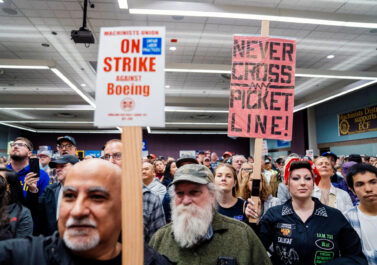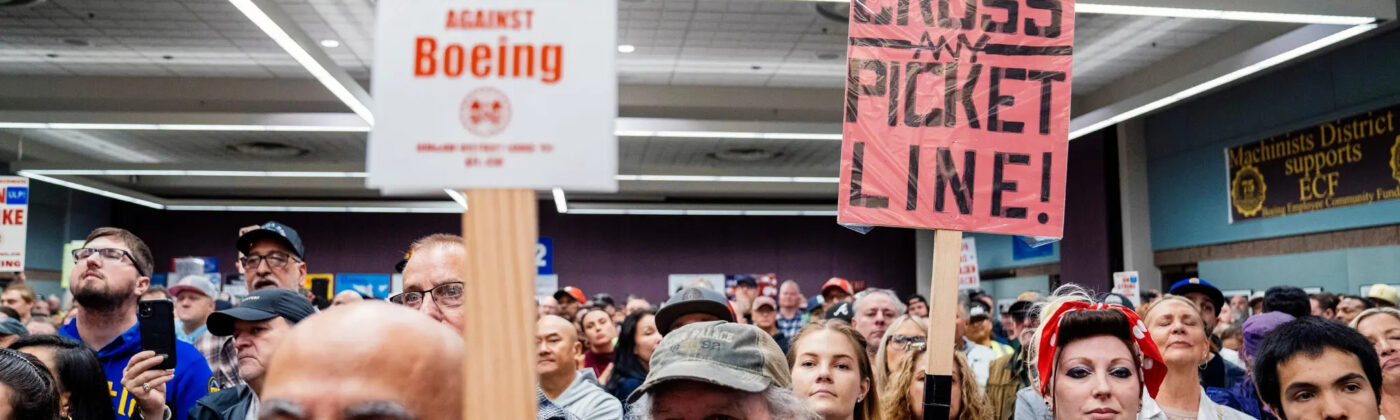
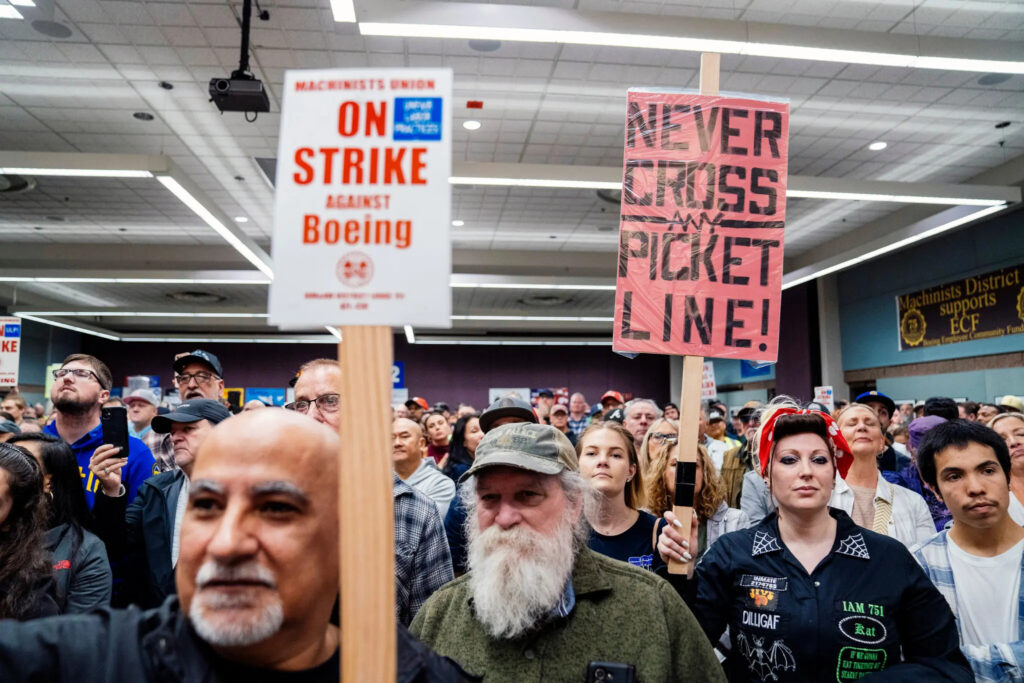
From the 13th of September to 4th of November 2024, 33,000 Boeing workers went on strike in the Seattle metropolitan area. That is where Boeing was founded 110 years ago, and where its two largest factories are located. In terms of workforce (182,000 in civil and military divisions), the group is the world’s largest aerospace company. In terms of new orders for passenger aircraft, Boeing overtook its biggest competitor, Airbus (157,000 employees), in 2025 for the first time since 2018; in terms of actual production and deliveries, Boeing remained in second place. In terms of arms sales, Boeing is the fourth-largest global defence contractor. Historically, Boeing has been a leader in outsourcing strategies. More aggressively than other corporations, the bosses attacked working conditions and trade unions, which had a catastrophic effect on the safety of their aircrafts. [1] During the Covid pandemic in 2020, Boeing sacked ten per cent of its workforce; many, particularly older workers, did not return. They hired large numbers of young workers – and they are now ready to fight. The strike in the autumn brought the new workforce together.
We conducted the following interview on the 5th of June 2025 in Seattle. Translated from Wildcat no.115
Introduction
Could you briefly introduce yourselves?
K: I’m Ky, I’ve been working at Boeing for six and a half years and have been an IAM member (International Association of Machinists and Aerospace Workers) ever since. I work in the aircraft assembly in Everett, where we put the various parts together. So everything from the hydraulics, the wings, the seats, etc..
ET: Everyone knows me as ET. I also work in assembly, but in Renton. We assemble the wings. I’ve only been an IAM member for just over two years.
What’s the difference between Everett and Renton?
K: In Everett there are about 30,000 of us and we build the 777 and 767.
ET: In Renton there are about 12,000 of us and we build the 737 series. We have IAM members working here – that is, permanent staff – but also people from subcontractors who aren’t represented by the union.
Do workers move between Everett and Renton?
Both: Yes.
ET: Sometimes people want to move themselves, for example if they’re relocating and want to work closer to their new home. Sometimes they have to move. For instance, when the 787 programme ended, many came from Everett to join us in Renton.
They moved the 787 programme to Charleston, South Carolina. Do you have any contacts there?
K: I don’t personally. Charleston isn’t unionised. It’s hard to build contacts there. There have been attempts to establish a union there, but South Carolina is a right-to-work state. That makes it very difficult.
How many people does Boeing employ in the Seattle area?
K: Probably 100,000. There are not only IAM members and people from subcontractors, but also Teamsters and SPEEA members. The Society of Professional Engineering Employees in Aerospace is the union for senior engineers.
Living conditions
Boeing workers obviously earn above average. Just looking at the cars out there, there are some insanely expensive sets of wheels…
K: It depends. I’ve recently reached the pay cap; after six years, you get a significant pay rise. My hourly wage went from $29 to $48 – that’s pretty good money. So my partner and I could probably afford a two-bedroom flat; at the moment we have a one-bedroom. Since the pay rise, I spend less than a third of my income on living costs, whereas before it was more than half. And as for the cars out there: those people have got themselves into terrible debt to drive them. That’s also one of the reasons why so many people are stuck in the overtime trap. They work so much overtime because they want to treat themselves to something nice. They have to pay off $1,000 a month in car loans – so they have to work a lot of overtime.
ET: I can guarantee you that at most two of the many people who have their cars parked out there actually own them. The cars may be registered in their names, but only for as long as they’re paying the bank. They don’t really belong to them.
What’s your income-to-expenditure ratio like?
ET: I’m in a fortunate position; I’m still very young, not yet living on my own, so I can’t really speak from experience. I don’t pay rent, just phone, petrol and insurance, which takes up less than a third of my wages. If I were to move out and live in a rented flat in the Seattle area, there’d be nothing left of my wages.
What’s the average rent like in this area?
K: There’s hardly any difference in prices between Seattle, Everett, Renton and so on. My one-bedroom flat in Everett – which is quite far north of the metropolitan area – costs $1,800 a month. I have a colleague, a single mum with three children, who still has to live with her parents because she can’t afford her own flat. That’s the situation here.
What’s the average age at Boeing? During the Covid pandemic, they made a lot of people redundant; most of them didn’t come back afterwards. Boeing has lost a lot of expertise.
K: The workforce is getting younger; I’m 27. When I started, you’d always meet someone who’d been there for 30–40 years. I’ve been working at Boeing for six and a half years and I’m already among the top 25 per cent of the employee seniority. Some have been there for ten to 15 years, but most have been there for two to two and a half years. You hardly find anyone with 25 years’ experience these days.
How long does the induction take?
ET: I had two induction phases. The first was when I was hired, where I received general information and more specific details about my job. I was hired during a very hectic period when Boeing was just recovering from the Covid redundancies. They were trying to make up for the losses by increasing production volumes. I started alongside many people who, like me, had little experience. Ultimately, we had to train ourselves. We spent long nights studying drawings, internal processes and work instructions.
Were you paid for that?
ET: Yes, but you had little time to learn. You had to produce; they wanted to sell planes quickly. It was a constant juggling act between learning and applying, learning and applying – to meet the schedule.
Is there a Tier 2 pay system like in the car industry?
K: In the sense that some employees have a pension and others do not. If you’ve been working at Boeing since the 90s, you have special pension and health insurance entitlements. There are no differences regarding pay and other rights.
When the blind door of the Alaska Airlines 737 came loose (5th of January 2024), production was halted. What did you do during this production stoppage?
ET: In the days that followed, the company paid very close attention to compliance with safety standards. All tools were to be certified, all colleagues had to understand the drawings, grapple with the technical geometry, and so on. But as soon as the public eye had moved on, a lot of these safety issues vanished immediately. It was soon back to business as usual, which means: speed. The faster we finish the products, the more money they rake in.
In Charleston, they’ve cut staff numbers in the quality department by 90%. But there are 200–400 people on a plane! If that crashes… Did you raise this during the strike?
K: The Boeing managers talk about ‘quality-driven manufacturing’. But they alone decide what is done about specific quality issues. The new collective agreement now states that such decisions must be made 50 per cent by managers and 50 per cent by the union. Half of the board is now made up of union representatives. In the period leading up to the strike and around the time I was hired, there was immense pressure on quality control officers. They had to approve 99 per cent of the work I’d completed; they wanted to scrap that entirely. Every fitter and mechanic was supposed to approve their own work. An auditor was only to come once a year to check our expertise.
They wanted to shift all the responsibility onto the workers?
K: Exactly. But we prevented that. I’ve been thinking a lot about that recently. I’m still impressed that our union managed to achieve that.
Strike
[The strike ran from the 13th of September to the 4th of November 2024; the presidential elections took place on the 5th of November.]
Let’s talk about the strike in autumn 2024. What were the demands? What was the mood like?
K: The demands were very high at the start. Our IAM District distributed leaflets and brochures about this in the break rooms. We wanted to get back the pensions we used to have, higher wages and more holiday leave. We didn’t get the pensions back. I have mixed feelings about the outcome.
ET: The general mood was very good at the start. In the first vote, 96 per cent were in favour of a strike; people were ready. It was about the first radical, structural change to the collective agreement in many years.
K: There had been no collective bargaining since 2008. For 16 years, they had simply extended the collective agreement. And the last extension, where people’s pensions were taken away, lasted ten years – with minimal pay rises below the rate of inflation.
One key demand concerned cost-of-living adjustments (COLA).
K: We’d had COLA in the agreement all along, but based on the average cost-of-living increase across the whole of the US – not on the basis of Seattle’s, which is higher. Unfortunately, that wasn’t changed. We got a 38 per cent pay rise over the next four years.
Was the strike also about equal pay?
ET: We demanded that new hires be able to reach the same pay grade as their more senior colleagues.
What did you do during the strike?
ET: I was at the picket line with friends the whole time. I’m young and have no other commitments. The first week was very exciting; loads of people turned up at the picket line spontaneously. It was lovely to see that people really wanted to be there. But without any prospects, that kind of spontaneous enthusiasm can quickly fade. And that’s exactly what happened. Each week there were fewer of us at the picket line. At certain gates, we lost the picket line entirely because nobody was coming anymore.
What was the reason?
ET: There were many reasons for that. For example, the arrangement of who was to stand at which picket line at what time was very arbitrary. Most people are used to their shift system, but were assigned to a picket line regardless of that. I myself work the second shift in the afternoon, but was assigned to the picket line for the third shift (night) or very early in the morning. These are times I’m not used to. A second reason was that you received strike pay regardless of whether you turned up at the picket line or not. That didn’t help to motivate people. Many stayed at home and the picket lines collapsed. The strike pay wasn’t particularly high either.
Did you discuss the reasons for this passivity?
ET: We did discuss it with our colleagues. We knew this attitude wouldn’t help to conduct a long struggle. But there was no discussion of it within the union leadership. We’re still fighting to get a list of the strike-breakers. The union leadership had instructed the picket captains not to report or identify any strike-breakers. That’s very suspicious.
K: They had ten years to prepare for this – but the whole idea was then that people would go to some union office and sign up to the strike list to get strike pay. That’s what most people did; after that, they held up a placard for another two hours, then went home. That was the extent of our duty for nine days. There was no training on why it’s important to stand on the picket line, or that you shouldn’t let strikebreakers through. There wasn’t even a discussion about it. Towards the end of the strike, I found myself in the role of a picket captain – without any training, and nobody was told that I was now taking on this task. I was just told to secure the entrance and answer phone calls.
So the union wanted to have full control over the strike and its conclusion at all times. I read about a group that, before the third vote – when it was clear the agreement would be accepted – distributed a leaflet calling for the struggle to continue.
K: That was us!
What arguments against accepting the collective agreement did you put forward in it?
K: We referred to the demands at the start of the strike. Those were really good demands, but just a few days before the first strike vote they were completely changed. It went from a 40 per cent pay rise, backdated pension payments and other rather fantastic things to much lower demands. Boeing’s offer was only 18 per cent over four years and a one-off payment of over $3,000 anyway. And the union leadership accepted that! But we rejected it by an overwhelming majority: 94 per cent against the agreement, 96 per cent in favour of a strike. That was an expression of immense anger.
People felt cheated: first they talked as if we were in for a really good deal, and then – what on earth are they asking of you? Are we supposed to agree to a contract we’ve waited ten years for and which then changes absolutely nothing!? Boeing has portrayed the contract as better than it really is; for example, they’ve highlighted the bonus paid when signing the agreement. The leaflet was meant to set the record straight on that. The bonus is just a one-off payment and the pay rise is far too low. Our leaflet simply wanted to say: “Hey, the news is saying that the agreement is great. But we’re telling you what it really means and what’s in it.”
How did you know what was in the agreement?
ET: The contract was publicly available, but you had to piece the details together yourself. They only publicly mentioned the big things, like the signing bonus and so on.
War
Boeing is the fourth-largest arms manufacturer in the world after Lockheed Martin, Raytheon and Northrop Grumman. How was the strike generally received? In the community, in the left-wing scene … ?
K: I’m organised with DSA Seattle myself [Democratic Socialists of America, the largest left-wing organisation in the US with 100,000 members]. My comrades came to see me at the picket line. Other left-wing groups also showed solidarity, dropping by and bringing food …
ET: We saw many left-wing groups at the picket line. They ranged from the DSA to other Marxists. Some were just there to show their support, others came to discuss Boeing’s role in the arms industry and international imperialism with the picketers. It was a bit like a training session. In Renton, we mainly produce civilian aircraft; only a very small part is related to armaments, namely the production of the P-8, a 737 derivative for maritime reconnaissance [and in Everett, the KC-46 is produced, a 767 derivative for aerial refuelling]. That is why these interventions had little success. Especially when the Israel-Gaza conflict was raised, it became clear to me that most colleagues are quite ignorant about it and do not want to engage with the issue.
The situation is no different in Europe. Some European countries with a social welfare system that is acceptable, at least when compared to the US, are currently shifting expenditure towards armaments and the military. The money is to be channelled into weapons programmes. The trade unions and – as far as I can tell – the workers too have so far ignored this. Only a small minority opposes arms production. At least there is the ‘Mask off Maersk’ campaign. Do you see any signs of a peace movement?
K: I know a few people from that campaign and wanted to get in touch.
ET: Public opinion is shifting right now. I certainly see a stronger mood against war and imperialism. But as welcome as that is, public opinion cannot go any further. It is very important that workers’ movements – and we within those movements – spread such ideas. Ultimately, this is where the real power lies. We have the power to refuse to work, to refuse to work in the production of these weapons of war. We therefore also have a responsibility not to ignore this and not just to look at what we’re going to put in the garage next. Our group is currently trying to organise things around the question of militarisation.
Organising
By ‘group’, do you mean the DSA?
ET: No, I’m not a DSA member. I mean our information group within the union. We publish articles on class consciousness, current events and issues relevant to the average IAM worker. We try to confront people with certain issues and want to get them to think about them.
Can you bring your ideas and demands into the union, and does anything actually happen as a result?
K: It’s tough. Most meetings revolve around bureaucratic procedures. There’s very little time for issues that really make a difference. Recently, a colleague from another local was arrested by the immigration authorities (ICE) and detained at the Tacoma Detention Centre. The union president, John Holden, only spoke about it for 30 seconds during the regular updates. But it’s not like in many other unions in America, where you’re immediately kicked out if you step out of line. We write about these things in our newsletter. We try to bring together everyone who shares our views. I know there are plenty of such people out there, because I’ve seen them at other protests and union actions; for example, I’ve seen IAM members at Starbucks Workers United actions. So they do exist.
Can you organise a few colleagues to go with you to the union and/or DSA meetings? Or to rallies/demonstrations like the No Kings demos?
K: I find it really hard to get my friends involved in these things. I get the feeling that everyone’s just scraping by at the moment. In my area, lots of people are doing overtime because they have to pay their bills. After that, you don’t have the energy left to protest. Especially if you’ve got children as well.
ET: Personally, I haven’t managed to bring new people along yet. But I do bring up political issues in conversations with my colleagues. Partly to see where they stand. To be honest, before the strike, it was a bit unsettling listening to my colleagues. But since Trump won the election and has been making his mark on politics and the economy, the contradictions have become all too clear. Colleagues who used to sympathise with Trump are having second thoughts and are re-evaluating a few things. It’s good to see that they now understand that Trump never had their interests at heart from the start, but it’s a bit late.
The Pacific Northwest is, after all, the more liberal part of the US. Do you actually have Trump supporters among your colleagues?
K: I had a crazy experience at a fairly large picket line when I was handing out one of our leaflets opposing the ratification of the collective agreement. Other left-wing groups were there too, as well as a group of workers, including a trade union official wearing a Trump cap and waving an American flag about. This group then questioned me about who I was and whether I really worked at Boeing. They claimed I was the one who had written a certain anti-Israel paper and that they did not share those views.
ET: At the start of the strike, I discussed with a few union colleagues that there would be conflicts because the presidential elections were approaching. When we were campaigning for a ‘No’ vote ahead of the third ballot, we spotted the Trump supporters. Because when we asked why they wanted to approve the contract, some said that Trump would win the election and sort it out! So there would be no reason to strike anymore.
What do your colleagues think of the tariff policy?
K: Objectively speaking, the tariffs are bad. But there’s a much darker side to it. Trump is pushing tariffs primarily against smaller companies. Boeing simply donates a few million dollars to his campaign and then gets exemptions. For example, Rolls Royce in the UK has an exemption; it’s one of Boeing’s most important engine suppliers. In my opinion, the motive behind tariffs is largely to concentrate power within the big corporations. Boeing might see it that way too. If Boeing really had to pay as many tariffs as other companies, it would suffer quite a lot. Because most parts and raw materials don’t come from the US; they aren’t even available here. It’s corruption. Boeing gets exemptions, Amazon and Apple get exemptions.
What is the racial makeup in your factories? Is racism an issue?
ET: Very mixed. I work with lots of Asians, African Americans and people from the Pacific Islands. I haven’t personally experienced or noticed any racism myself. That doesn’t mean it doesn’t exist, but we’re so busy we wouldn’t have time for it anyway. In a way, it’s nice that everyone tries to get on with one another.
Sometimes there are foremen who use racism …
K: I’ve definitely noticed it. When I was working on the 767 programme, I had a colleague who earned between $200,000 and $250,000 a year because he worked an enormous amount of overtime. He has a house in Japan where he spends all his holidays. He’s going to start a family there. Once in the break room I was eating with him and he went on and on about how great segregation in Japan is and that it would be good for the US too. I said, we’ve had that here already, it was called Jim Crow. And then there was a guy from quality assurance sitting next to us, who looked me in the eye and said: Jim Crow wasn’t so bad.
Was the bloke white?
K: Yeah, of course. They’re all white blokes.
So there are all these anecdotes, but if I’m understanding you correctly, the problem isn’t constantly present to the extent that it prevents class struggle?
K: No.
After the strike
How did the strike affect your situation at work? Did some conditions improve? Do you have a bit more time than before, or has the work become more intense?
ET: They make money with the 737 programme in Renton, which is why production is focused there. Everett is split between production and rework. The strike obviously hit Boeing hard financially. So they wanted to get production up and running again quickly to bring in money. Unlike the period following the Alaska Airlines incident with the blind door, production is running non-stop. Today I was almost late for the union meeting because I was still working overtime into the night shift. That’s common at the moment; they’re ordering overtime at very short notice. They’re constantly trying to increase production figures, so many of us are working overtime late into the night. Some are working ahead, some have to catch up. But problems arise faster than we can fix them. In short, things are very hectic for us at the moment. People are exhausted and are now regretting that they agreed to the collective agreement in the third vote.
But wasn’t the strike specifically against compulsory overtime!?
ET: Yes. I’ll say it again, it’s nice to see that many people are saying: ‘we should have fought harder’. But it’s a bit late.
K: Everett’s a bit mad in that respect. I’ve got a few colleagues who voted for the agreement so they could get back to their usual overtime. Some work more overtime than they actually need to. They have this very toxic work ethic: if I slog away for four weekends in a row, then I can buy that stupid thing. But for many new people, it’s also about being able to pay their bills. And then there are colleagues who get depressed without work because they don’t know what to do with their time or with themselves. As far as working conditions go, things are a bit better in Everett after the strike. Before the strike, they’d ruthlessly push every 777 through production to meet targets, regardless of rework or missing parts. So planes piled up, sometimes missing a door, sometimes the engines, sometimes the windows, and so on. That went on for months. When they ran out of space, they finally realised how ridiculous it was. Since the strike, they’ve been keeping the planes on the assembly line until they’re actually ready for the next production stage. In that respect, the strike has brought them to their senses a bit. Other things are continuing exactly as before. Just like at ET’s place, colleagues are now saying that we should have fought harder during the strike. They’re now starting to question things and prepare for the next collective bargaining round in 2028.
***
The day after the interview, on the 6th of June 2025, a rally took place in Tacoma against the aforementioned detention of IAM colleague Maximo Londonio. On the 7th of June, protests against ICE began in LA.
On the 12th of June, a Boeing 787 crashed in India. 260 people died.
On the 14th of June, No Kings demonstrations took place across the US. In Seattle, over 70,000 people took to the streets, slightly more than at the anti-WTO protests in 1999.
From the 3rd of August to the 13th of November, a collective bargaining strike took place at Boeing Defense, the defence division. This generated less momentum (see Wildcat 115, page 39).
[1] https://www.wildcat-www.de/wildcat/113/w113_boeing.html