Translation from Wildcat with additions from AngryWorkers
Since the 13th of April, a mass workers’ uprising has been raging in the southern industrial areas of Delhi. On the one hand, this was a direct response to the rising costs caused by the war in Iran; on the other, workers’ protests had been taking place repeatedly in industrial centres since the start of the year. They demanded shorter working hours, higher minimum wages, higher overtime pay, payment of outstanding wages and equal working conditions for temp workers and permanent staff.
The background: Yellow Helmets and inflation
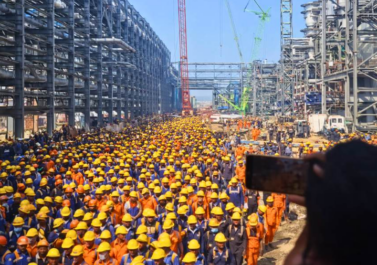
Between January and March 2026, at least 28 major strikes and workers’ protests took place across India, most of them at industrial construction sites. A brochure by the Migrant Workers Solidarity Network documents this movement as the ‘Yellow Helmets’, as the protesters are mostly construction, oil and steel workers wearing yellow helmets. Their main demands were for outstanding and higher wages, as well as better safety measures and shorter working hours, with a maximum of eight hours per day. For example, in Panipat, following a workplace accident that left two workers dead, 30,000 agency workers at India’s largest oil refinery took to the streets, pelted security forces with stones and damaged their vehicles. In Hazara, more than 2,000 steelworkers went on strike, drawing direct parallels with the struggle of the refinery workers in Panipat. The demands for higher wages and an eight-hour day had a mobilising effect, particularly on construction workers, but also spread to the textile and energy industries – in Gujarat, workers at Alok Textiles and in Mundra, at India’s largest coal-fired power station, went on strike.
The Iran war triggered an energy crisis in Asia that is directly affecting Indian workers. Migrant workers’ wages are now even less sufficient for survival, as the price of LPG, which workers use for cooking, has risen sharply. Local governments had promised to raise minimum wages by 35 per cent with effect from the 1st of April 2026, but either this did not happen or the increase was far too small. As early as March, shortly after the start of the Iran war, thousands of nurses in the southern state of Kerala went on strike demanding a doubling of the minimum wage. On the 3rd of April, Honda and Scooter India workers in Manesar demonstrated for a higher minimum wage.
Uprising in Noida
On the 8th of April, workers in Noida, a suburb of Delhi with a population of 650,000, joined the protest. With thousands of industrial firms, including those in the automotive supply and electronics sectors, Noida and the wider industrial belt of Delhi is one of Asia’s largest industrial centres. The workers demanded the 35 per cent increase. For a week, they were ignored.
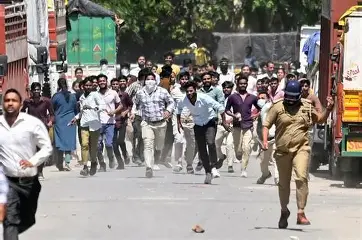
On the 13th of April, their anger erupted. Between 40,000 and 45,000 workers took to the streets. “Factory workers from dozens of plants in the Noida industrial area staged violent protests on Monday to demand better wages and working conditions. They threw stones, destroyed vehicles and set several of them on fire,” wrote The Indian Express. Factory buildings were also set on fire. In many instances, the police deployed to the scene were forced to flee. In videos uploaded by the workers themselves to platforms including Instagram, one can see a demonstration marching through a factory hall, with workers shouting: “Meet our demands!” In another, construction workers are demolishing a building. Yet another shows a walkout from an IT office.
On the 14th of April, domestic workers joined in; on the 15th of April, gig workers gathered and also made wage demands. The uprising spread to other areas – from Gurgaon via Faridabad to Noida, workers are fighting. It is the largest wave of strikes in the region since 2014/15. And unlike then, it is not confined to the textile and automotive sectors. One of the differences between 2014/15 and today is that we haven’t seen any longer factory occupations yet, but rather street blockades. An interesting factor in the spreading of the uprising is the fact that various companies have factories in different, often fairly distant industrial areas. When workers at Richa garment company went on strike, were attacked by police in Manesar and retaliated, the workers at Richa factory in NOIDA started their strike in response. The Mothersons factory played a similar role, as first the workers in NOIDA walked out, then workers at Mothersons in Faridabad and Bhiwadi, which is roughly 90 kilometres away in Rajasthan.
Local comrades said that a few ‘egalitarian’ sentiments prevailed during the movement: “we are doing the work in the factories, why does the ‘staff’ (management, white-collar workers) walk away with all the money” and “why are the minimum wages different in each state” (The industrial area is clustered into different states: Delhi state has its own minimum wage, NOIDA pays Uttar Pradesh wage, Gurgaon or Manesar the Haryana wage, Bhiwadi workers get the Rajasthan minimum wage. Differences can be considerable).
In an initial response, the local government announced it would raise the minimum wage – though, as things stand, by well under 35 per cent. It has also invoked ‘Article 163’, a ban on assembly. But the workers are not complying. Now the state is attempting to restrict social media (including Instagram, where the videos are proving quite mobilising). This, too, has had only limited success. Under police protection, company managers are reading out to workers the improvements and pay rises they will be implementing. Trade unions are currently struggling to restore calm. Marxist-Leninist groups are calling for people to remain peaceful and ‘not to spread anarchy’.
Assembled in India?
This workers’ uprising – particularly the demand for shorter working hours – is the culmination so far of a development of global significance. For since the Covid strikes by Foxconn workers in China in 2022, Apple in particular has been attempting to shift more and more of its production to India and move away from its ‘Assembled in China’ strategy – with the support of the US and Indian governments. As early as 2024/25, the first struggles and organising successes in the Indian electronics industry indicated that this would not be so easy.
Indian workers are radically opposing the ‘global race to the bottom’!