“The moment the struggle becomes your own, it’s a moment of proletarian celebration, where everyone manages to find their own identity; they’re no longer cogs in a machine, they’re a series of minds coordinating and directing themselves and others. Otherwise, what would be the point of occupying a factory?“
We translated this text by Chicco Galmozzi, originally published by Machina. You can watch a longer interview with Chicco Galmozzi here. He was a worker and activist with Lotta Continua. In 1974, he participated in the founding of the Communist Committees for Workers’ Power linked to the newspaper “Senza Tregua”, and in 1976 he was among the founders of Prima linea. Arrested in May 1977, he earned his high school diploma and college degree during his twelve years in prison. The following account can be read in unison with this longer text by the political committees at Siemens, Pirelli and Alfa Romeo, who formed around the same time as the occupation at Fiat Mirafiori took place. For a UK context you can also read this account written by a comrade, who took part in the occupation of the aerospace factory where he worked in 1974.
—————————————————-
We are publishing an excerpt from Chicco Galmozzi’s book “March 1973. Red Flags at Mirafiori”, recently published by DeriveApprodi, fifty years after the occupation of the Fiat Mirafiori plant by the so-called “red handkerchiefs.” The book offers a historical reconstruction of the events that led to the occupation of the plant, the high point of the cycle of workers’ struggles that began in the second half of the 1960s.
* * *
On the 17th of March, from the moment the first shift arrived, workers in all Fiat sections reacted negatively and with anger to the news of the draft agreement with the employers’ association Intersind. The attempt by union activists and PCI members, who were present in large numbers at the gates, to distribute a leaflet calling for calm, stating that what had been signed was only a draft and not the actual contract, was to no avail. Thus, during the first and second shifts, work stoppages and internal protest marches followed one another. At the center of the workers’ attention and initiative was above all the demand for a preliminary ruling on the bosses engaging in retaliatory dismissals (four in the last week alone) to be included in the negotiations. It is on this issue that the difference and the split lie between the purely demand-oriented line – and, moreover, a downward-trending one – of the trade union federations on one side and the perspective of workers’ autonomy on the other. The latter made the struggle against factory despotism the central and decisive issue for establishing the balance of power in the workshops and departments.
It is also highly significant that workers’ criticism of the contract draft was directed not so much at the wage provisions as at the rollbacks regarding the single unitary pay scale and the lack of automatic promotions upon category advancement. This was not merely a matter of generic egalitarianism, though it was deeply rooted in the working class, but a radical critique of the Taylorist organisation of labor and the factory despotism that imposed it. In the name of egalitarianism, the fragmentation of workers into fixed, rigid categories was called into question.
The unions championed the slogan of the ‘recomposition of tasks’ as a way to overcome the Taylorist organisation of labour. Taylorism is based on a scientific division of work tasks which, through the fragmentation of general tasks, allows for the assignment of elementary tasks to each worker, thereby reducing the time it takes to train workers, and increasing their ability to perform their individually allocated micro-tasks. The work process is broken down and reduced to a few repetitive gestures and movements. Workers’ autonomy was not hostile to the idea of the recomposition of tasks, but focused rather on the rigid division ensured by the range of qualifications as a tool for dividing the working class. But, above all, the lack of automatic transitions between categories left ample room for (arbitrary) discretion on the part of the corporate hierarchy, which managed these transitions with a logic of reward – and thus blackmail. If layoffs and disciplinary measures were the stick, a promotion to a higher category was the carrot to be awarded to the deserving.
From the 22nd of March 1973 onwards, the struggle spread throughout the Turin area, intensifying day by day. On the 28th of March, an autonomous 8-hour strike was held against the layoffs; the following day, an internal march of 10,000 workers took place, which blocked the entry and exit of trucks, thereby succeeding in bringing production to a complete standstill. On the 29th, the Fiat Mirafiori plant was occupied for three days; the following day, the blockade spread to Lingotto, Bertone, Pininfarina, Spa Stura, Carello, the Carmagnola Foundries, and Sicam in Grugliasco. On the 30th of March, all the factories in Turin were in the hands of the workers: red flags at Mirafiori, thousands of workers picketing the gates. Mirafiori remained blocked all morning, completely in the hands of the workers. At the Carrozzerie (body shop) department, the unions had called for a two-hour strike starting at the beginning of the shift, but the logic by which the workers were making decisions during these days of their struggle was now entirely different: no one started working; after a march of 10,000 people, the workers split into groups of hundreds and spread out to the various gates.
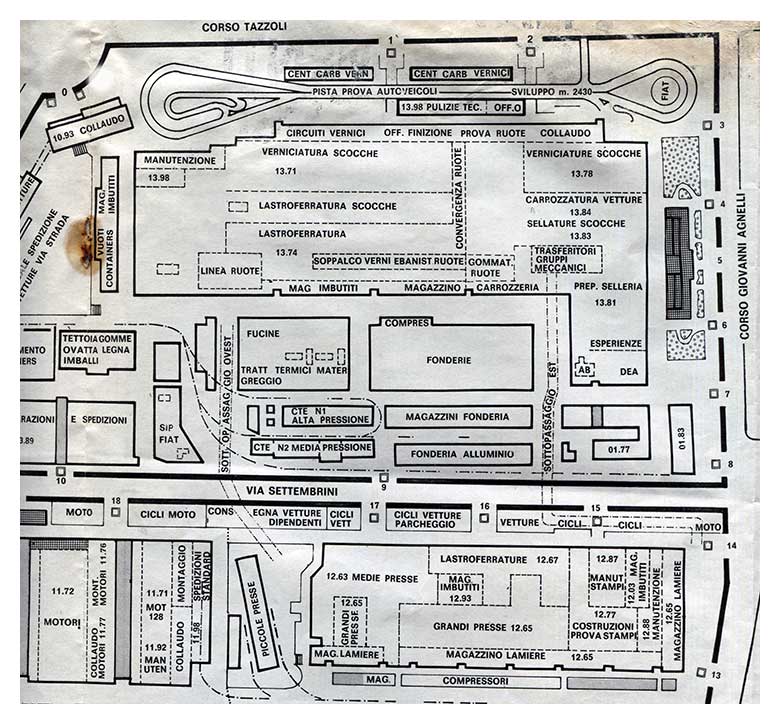
All 12 gates had their own picket line: from the inside, the workers prevented the entry and exit of goods. The picket line was also extended to the office building. The workers gathered at the gates and thereby resolved brilliantly the difficult organisational problems that blocking a factory like Mirafiori entailed. This happened in the absence of any initiative from the union, which had been sidelined from the struggle. Continuous communication was established between all the gates, using bicycle couriers. The workers filled the gates with red flags and banners. “The laid-off workers are with us in the factory,” and another: “Guaranteed wages.” The names of all the vanguard workers purged from Fiat were written on a red banner. At Gate 9, a mannequin of a hanged man was placed with the inscription below: “This is the end of the workers’ enemies.”
The Carrozzerie (body shop department) was the center of the workers’ power; the strike continued uninterrupted until the end of the shift. It didn’t even occur to anyone to go to work. At the Meccaniche (mechanical / power train shop), the workers stopped work at 9:20 a.m., the start time of the three-hour strike called by the union. Huge processions marched through the mechanical works No. 2, exited onto Via Plava, and after circling the entire factory from the outside, they re-entered by breaking through Gate 15 and storming the press shop. While the majority of workers were marching, the others remained inside to block goods between the various workshops. Hundreds and hundreds of workers gathered in front of the gates to discuss the forms of struggle for the coming days, all determined to see this through to the end. Union officials and PCI bureaucrats are trying to keep as low a profile as possible, isolated as they are from the workers’ strength. Where they could, they played the role of peacemakers; in most cases, they remained silent.
Around noon, an assembly of about a thousand workers discussed how to proceed: it was decided to continue the blockade of goods tomorrow as well. And if negotiations dragged on or if the bosses even broke off talks, the workers decided with a roar of approval, that they must go to Corso Marconi – a main avenue in town centre. Meanwhile, at the Carrozzerie, picket lines continued at all the gates as they awaited the second shift. Practically no one had left all morning. The very few who did leave had to evade the surveillance of dozens and dozens of workers perched on the walls and gates. At the Meccaniche, the strike ended at 12:30 p.m. At the shift change, the thousands of workers blocking the gates did not remove the picket lines until all the second-shift comrades had entered to replace them. Those arriving, however, were carefully checked: the bosses and all known scabs and fascists were kept out. It was a mass popular process that filtered, judged, and selected the workers’ friends and enemies one by one.
A worker’s account of those days.
“The workers realised they needed to find forms of struggle that would demonstrate their strength. It began with the moment that split the workshops and departments, everyone would take a quick protest march and then that was it. So we started proposing a “purge” of the delegates, and getting rid of those who aren’t with us. We’ve been fighting for five months; we know them all, and there have been so many delegates I’ve never seen except when there’s a motion to be made against the so-called extremists. We made a series of contacts with the power-train shop, so they would come to us. On Monday, after the march, we arrived at Gate 11, which is the main one where the trucks, containers, and customs go through. And there we found the cars, ready to leave the factory. We asked the guards for the keys. The boss was on the phone with management. The guards called out, “Over and out,” and took off. Then the gate flew open, and this was the so-called Teano reunion with hugs and kisses. There was a bit of confusion, because no one knew where to go; some of the delegates and workers wanted to go to Meccaniche because there was a line of people heading that way. So I climbed up a small mound of grass where there’s a little tree that Fiat maintains to show they care about the environment – just tufts of grass in the middle of the concrete.
I said that now that the two sections were united, we had to keep going and block the gates, at least the vehicle gates. And I reiterated once again that we must get rid of those who don’t take the needs of the masses into account. I told them not to keep going on about the 8-level job category system, because we’re fighting for the 5-level system with automatic pay increases – and this infuriated two or three delegates from Meccaniche. The comrades took the instructions and divided up the gates; there we blocked them for a couple of hours, and we immediately realised, from the number of trucks stuck outside the gates, the effectiveness of our struggle.
At the end of the official union strike, we went back inside and swept through the areas where a few stragglers were still working, and we explained to those who had stayed inside the new form of struggle and our satisfaction with it. On Wednesday, the first shift held the usual three-hour strike; the second shift in assembly at 2:30 p.m. didn’t even start working – they held an internal march – and then at 3:30 p.m., Fiat sent the entire Verniciatura (paint shop) home. The paint shop held its own march as well, and it was time for the union strike. The instruction from the day before was to meet directly at 4:00 p.m. at Gate 11; it was an instruction I had given the day before, though I wasn’t entirely convinced it would go so well. I left the workshop at 4:00 p.m. and there was already a gate blocked by dump trucks, workers blocking the trucks with their factory vehicles, arguments with the drivers, a thousand little groups, people gathered on those famous little lawns—in short, a real buzz of activity.
We went to block the intersection of the internal avenues leading to Gate 11. Another section of the procession arrived that had been circling inside. We divided up the tasks; it was decided that Lastroferratura (sub-assembly) would also extend the strike until 11:00 a.m. A delegate from the union’s left wing made that decision. The absence of PCI leaders was glaring. Bicycles suddenly appeared; we weren’t sure whose they were, but then we realized they belonged to the scabs – the workers had simply removed them from the rack. We organized the relay teams. I set off with a group of comrades to go to the cafeterias to explain the new form of struggle to those who were eating. They were a group of very young and combative comrades. We went around the cafeterias, table by table, gathering support, and they told us: “It’s about time! Did it take five months to figure this out?” So we explained the situation regarding the delegates – that is, we’d organised ourselves independently. We kept the good shop stewards, the ones who were de facto representatives; the others had effectively marginalised themselves, those who took orders from the various union headquarters.
That’s where we saw delegates playing cards; the workers introduced them to us: “Here’s our delegate.” At 9:00 a.m., the foundry workers arrived asking for information. So we used the security guards’ phones and arranged to meet at the end of the shift in front of Gate O to assess the situation. Some union bigwigs showed up at the gates to play the firemen, and the workers told them to go play firemen somewhere else. A PCI union official said that the authorities – the PCI, the PSI, Donat Cattin – had already been invited for the symbolic occupation on the 3rd of April; and what would become of us if they found that the factory had been occupied not just symbolically. He was very interested in local government bodies; he was far more interested in their issues regarding seats on the Regional Council. The assembly: the left-wing delegate, the same one from before, said that this struggle is going well, let’s hope we have the strength to carry it forward, etc. I spoke afterward, adding a few more points; I also mentioned the other shift, that I was sure it was continuing the struggle, and that we needed to organize the other shift, as well, because it has the same needs.
At 9:00 a.m. on Thursday I was asleep; a comrade called me and said that all of Mirafiori was occupied, all the gates were manned. At 10:30 a.m. I arrived with my wife and child, because she also wanted to know what an occupation was, since at home I always talk about the struggles that are taking place. My son is 6 years old; we went all the way around the gates. There were flags waving everywhere. He asked me, “But who are those people on the roofs with the flags?” and I said, “They’re the workers; they want to beat the boss.” And he said, “But the boss isn’t there,” and I said, “Look, the boss is never in the factories; he might be in his private helicopter right now, looking down from above at his factory slipping through his fingers.” Then we met another comrade with his son, and we introduced them. The moment the struggle becomes your own, it’s a moment of proletarian celebration, where everyone manages to find their own identity; they’re no longer cogs in a machine, they’re a series of minds coordinating and directing themselves and others. Otherwise, what would be the point of occupying a factory?
There were the scabs who were so steeped in the boss’s fairy tales that they came asking if a written permit was needed to leave or re-enter. I told him: “Look, we’re not foremen here,” I explained to him that we strike directly at our class enemies; we don’t use all the boss’s tools like he does – we effectively suspend those who are against us. At the shift change, perhaps the most beautiful moment occurred. At the gates of the Carrozzerie, they decided to rotate the gate blockades to ensure the blockade remained solid throughout the entire shift. I’ve never seen anything like it. Workers arrived and saw all the red flags, workers in overalls on the gates and all along the wall. In short, something a bit different from the usual. But the most exciting thing – and the one that gives you a sense of the workers’ strength and consciousness – was the checkpoint. It had been decided that only workers would be allowed in, not the bosses. Everyone at the gates was saying, “Today, only comrades inside, the cowards out,” and so the blockade was also set up to stop the scabs. You should have seen it: all the comrades were there checking ID cards at the entrance, with the gate ajar. They entered one by one, and everyone had to face the judgment of the striking workers. The word spread across the entire square, while those at the gates and on the wall signaled to the doors the arrival of the managers, the bosses, or the most well-known scabs. There was no need for violence. The boss would arrive and everyone would shout in unison: “Get out, get out, we’re in charge in here today, only our fellow workers get in.” They’d give a forced little smile and walk away shaking their heads. There were a few who tried to raise their voices and left with a kick in the ass. With the scabs, however, it was different; there was also a people’s tribunal, where they were reminded of everything they had done over the past five months to our detriment. The hardened ones left; those who, for example, had gone on strike only once in a while, were re-educated. All the fellow workers were there, reminding them of every incident – because workers have long memories – and sometimes they did so in a harsh manner. Then they’d ask if they’d changed their minds, and if so, they’d give them a light slap and let them in, while those who said they’d never do it again were welcomed. And there was applause from everyone on the walls and all the flags waving. There were a few delegates grumbling and saying it wasn’t democratic, but they were drowned out. And then the other best thing was that everyone who went in knew they had to go clock in and then come to the gates; they went in fully aware and happy with what they were doing. There was absolutely no need for union officials, and I assure you no one felt the need for them. In the afternoon, a few people showed up – but not many – to give patronizing speeches about how this was bigger than us, that we had to be careful. And the workers would gesture at them with their hands, saying, “But you’ve really got this ‘single job classification’ stuck in your heads,” and they’d laugh.”
Late on the evening of Monday, the 2nd of April, the FLM trade union and Federmeccanica reached an agreement whose key points were: the abolition of categories and qualifications through a single pay scale; a monthly wage increase of 16,000 lire for everyone; a reduction of the weekly workweek to 39 hours through the granting of one day off every eight weeks of work; one additional week of vacation; recognition of the right to education through the granting of 150 paid hours. Even though some considered it a “rubbish contract,” it was a good contract. The last great workers’ victory. Won by force.
What came to an end in the spring of ’73 was not merely a cycle of workers’ struggle: for five years, from ’68 to ’73, the factory proletariat was not only a class in itself but a general class, capable of rallying broad social sectors – from students to the lower and middle classes – and of exercising social authority. In the towns of the Turin belt, or in the Bergamo valleys, the shop steward at Mirafiori, Breda, or Falck carried as much weight – and perhaps more – than the mayor, the parish priest, and the pharmacist.
Faced with the obvious impossibility of bringing the working class back under the control of the bosses’ order and despotism, the response was to do without the working class by implementing massive restructuring and production relocation processes.
Now, where the factories once stood, shopping centers have sprung up that mockingly retain the old names: Lingotto or Vulcano in the area where the Falck factory of the same name once stood, in Sesto San Giovanni.
What remains of all this? Perhaps the legacy is that victory comes through force.
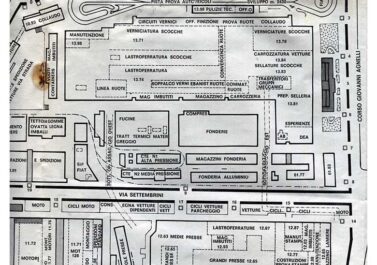
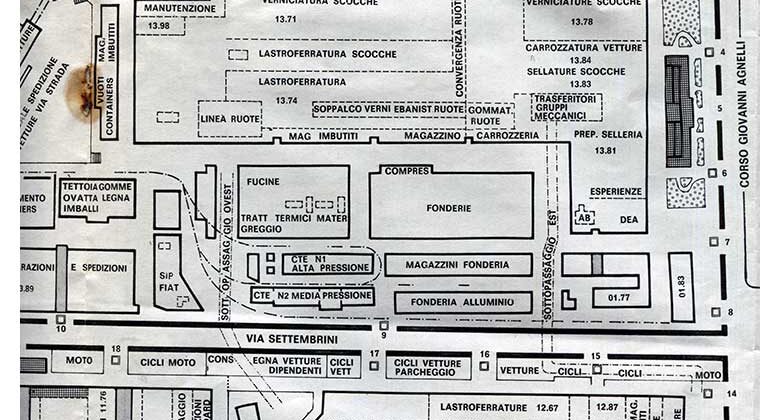
Image: Portion of a map of the Fiat Mirafiori plant, 1973
* * *
Chicco Galmozzi, a compelling storyteller, his work *Figli dell’officina. Da Lotta continua a Prima linea: le origini e la nascita (1973–1976)* (2019) appears in the DeriveApprodi catalog.