The next issues of the magazine Wildcat will focus on the question of who can stop Trump. To this end, we will examine class relations in the USA: ‘the lumpen,’ ‘the service proletariat,’ ‘tech workers,’ ‘industrial workers’ and ‘the undocumented,’ i.e. migrants without identity papers or legal residence status. In light of the dramatic escalation in Minneapolis, we are publishing this section in advance as a work in progress. (This section does not deal with Trump’s radical restructuring of the state; that will be covered elsewhere.)
Undocumented workers
In the United States, people without official residence permits are referred to as ‘undocumented’. Most of them are refugees from Latin America, Asia and Africa who can be easily deported, at least according to their status. Depending on the source, there are between 10 and 15 million undocumented. The latest estimates from the Pew Research Center and the Migration Policy Institute put the figure at 14 million (2023) – four per cent of the population. A study conducted in August 2025 was able to assign 8.5 million to specific sectors: 20 per cent in construction, 12 per cent in hospitality, 11 per cent in manufacturing, 10 per cent as support staff in public infrastructure, 8 per cent in retail and 3 per cent in agriculture. Although 95 to 99 per cent of the 8.5 million work continuously, only 53 per cent have health insurance. 52 per cent have been living in the US for at least ten years, 28 per cent for at least 20 years. Only a third of these workers have almost no formal education. The study assumes that the figure for agriculture (3 per cent or 300,000 undocumented migrants) is too low.1 According to data from the US Department of Agriculture, foreign-born undocumented migrants make up about 40 per cent of the total 1.2 million workers in the industry, which would be 480,000.2
In recent decades, undocumented immigrants have fought for and achieved significant improvements – not only ‘tolerated stay’, but recognition through the so-called ‘sanctuary policy’. This dates back to the church asylum movement of the 1980s, which supported civil war refugees from Central America under Reagan. ‘Sanctuary’ is a formal term and consists of laws, statutes, administrative orders, guidelines, resolutions and regulatory documents from various institutions, such as city governments, universities, states, company premises, etc. The degree of legal binding and formality is often related to the degree of legal autonomy of the respective institution. Many rules are informal and highly contested.3 Roughly summarised, a ‘sanctuary policy’ means that immigration enforcement agencies have been decoupled from social and legal infrastructures. In 2025, over 150 cities, counties and states practised this. ‘Sanctuary cities’ (New York City, Chicago, Los Angeles, etc.) have established themselves as relatively safe places for undocumented immigrants. There, they can obtain health and social insurance as well as government benefits (Medicaid, SNAP food assistance, etc.). Police officers and other officials do not ask about residence status or request documents. The police-military ‘deportation complex’ has no access to social security numbers.
Trump’s attack on the ‘sanctuary policy’
It is true that ‘Deporter-in-chief’ Obama, US President from 2009 to 2017, had already reversed the ratio between “returns” (rejections at the border or voluntary departures) and ‘removals’ (deportations) in favour of the latter. But Obama and others before Trump II did not organise raids and systematically deport people who had been living in the US for a long time and were integrated into social life there.
The ‘Project 2025’ paper, published in 2023, which serves as a blueprint for Trump’s second term, makes a clear statement on the ‘sanctuary policy’: ‘All ICE memoranda identifying “sensitive zones” where ICE personnel are prohibited from operating should be rescinded.’ 4 Trump is attacking the ‘sanctuary policy’ head-on.
According to the US Department of Homeland Security (DHS), 605,000 people were deported in 2025, 66,000 are in deportation detention centres, and 1.9 million left voluntarily. 4,250 people have gone missing since their arrest, 30 people have died in deportation camps, four during arrests and one during deportation. The number of deportations in 2025 was twice as high as the average for the years 2014-2024.5 However, there are indications that this figure has been artificially inflated by the ministry.
Over two-thirds of those arrested by the Immigration and Customs Enforcement (ICE) agency have not committed any crimes. Many others have been targeted for traffic tickets or drug use.
Trump’s SA?
Ten years ago, members of the right-wing militia Patriot Prayer threatened to ‘clean up’ the left-liberal sanctuary city of Portland. The Portland Bureau of Police was in close contact with Patriot Prayer and its leader Joey Gibson, who ran for the Republicans.6 For his attack on the undocumented, Trump has institutionalised right-wing militias such as the Proud Boys under the banner of ICE (the second immigration agency in the Department of Homeland Security is CBP, Customs Border Protection, the border protection agency). He pardoned Proud Boys boss Enrique Tarrio, like many others who took part in the storming of the Capitol. Tarrio introduced the ‘Iceraid’ app, which allows users to report illegal immigrants and receive cryptocurrency as a reward.7 Hardliner Tom Homan was ICE director under Trump I. After Trump’s re-election, he became border protection commissioner and met with Proud Boy Terry Newsome to discuss mass deportations.8
The current ICE director, Todd Lyons, wants to establish efficient deportation logistics ‘modelled on Amazon’ for the planned 3,000 arrests per day. The government is spending over 150 billion USD on this: investments in infrastructure and new personnel, the large US prison companies GEO Group and CoreCivic are building new deportation prisons, Palantir is programming anti-immigrant software called ImmigrationOS, and ICE is buying mobile phone data from advertising companies to track people using their location data9. They are all earning very well under Trump II (a third of all CoreCivic‘s revenue comes from deals with ICE alone). During the government shutdown from the 1st of October to the 12th of November 2025, Trump wanted to withhold money for food aid and thousands of civil servants were no longer paid – but he continued to pay the ICE and CBP thugs and gave new recruits a 40,000 USD hiring bonus, above-average health insurance and repayment of student loan debts over 60,000 USD. In order to get as many armed troops on the streets as quickly as possible, Trump has reduced the training period for new ICE recruits from 13 to six weeks and cancelled Spanish language courses. In October 2025, NBC revealed that new ICE personnel had been sent into service before the completion of official screening procedures and that some had failed drug tests.10
Even during the George Floyd rebellion, former Bush homeland security chief Michael Chertoff warned against the ‘politicisation’ of the Department of Homeland Security. The then NBPC president, Brandon Judd, had said in 2016 that immigrants were ‘worse than animals’ – under Trump II, he has now become ambassador to Chile! The NBPC (National Border Patrol Council) and NIC (National ICE Council) are the two unions in the Department of Homeland Security. Even back then, they were demanding more money and an expansion of their powers. They saw Trump as their natural ally, and Trump saw them as a potential power base. After losing the 2020 election, Trump tried to use the NIC and NBPC against Biden. The then Deputy Secretary of Homeland Security, Ken Cuccinelli, wanted to strengthen both unions. When that failed, ICE officials opposed the Biden administration. In 2022, they filed a complaint with the Department of Labour demanding more autonomy from the umbrella unions AFGE (American Federation of Government Employees) and the AFL-CIO, which they saw as ‘far-left organisations’.11 Cuccinelli then wrote the section on homeland security in the Project 2025 paper, where he calls for the abolition of ‘sanctuary cities’. Michael Macher, author of the online newspaper Phenomenal World, sees the right-wing hardliners organised in NIC and NBPC as ‘incubators for right-wing projects’ in the department.12
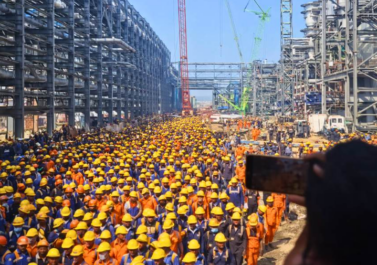
When Trump wanted to stop the raids in June 2025 after complaints from the agricultural sector, his fascist security adviser Stephen Miller allowed them to continue. After the raid on a Hyundai factory construction site in Georgia on the 4th of September, Trump was forced to apologise. ‘The close relationship between ICE/CBP and Trump has paradoxically begun to limit Trump’s own room for manoeuvre.’ (Michael Macher)
On the 14th of January 2026, journalist Ken Klippenstein published leaked documents showing that ICE is conducting secret operations. Among other things, they are trying to recruit informants within the immigrant community. ICE is even splitting the FBI over this.13
Resistance
Undocumented workers have repeatedly fought important battles throughout history: at the beginning of the 20th century, the immigrants, day labourers and migrant workers who built the US infrastructure (wood and railways) organised themselves as the IWW (Wobblies). The Wobblies were strong because they were incredibly mobile and well organised, but also because the capitalists could not build the transport routes without them. During and especially after the First World War, they were wiped out. In the 1960s and 1970s, workers in the fields of industrial agriculture organised themselves under the slogan ‘Sí se puede!’ (‘Yes, it is possible!’) into a large trade union, the United Farm Workers. In the mid-1990s and 2006, the undocumented mobilised once again for their interests, including mass demonstrations in major cities. In 2006, one of the slogans was: ‘We are workers, not criminals!’ During the mobilisations, millions of people took part in rallies in Los Angeles and Chicago for legalisation and against tougher immigration laws.
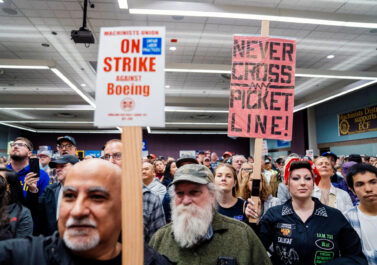
After Los Angeles and Chicago, Portland was the next major city that Trump declared a war zone and training ground for deportations and riot control in 2025. Broad social opposition to this developed in the cities. Depending on the context, people organise themselves in different ways: in Portland, left-wing groups and anti-fascists stand in the way of ICE troops14, while in Chicago and Los Angeles, this is done by large parts of the neighbourhoods and Hispanic community (including lawyers, etc.)15. In Seattle, Boeing union members, among others, are organising rallies in front of deportation centres to demand the release of one of their colleagues.16
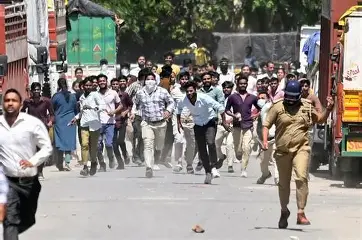
The vast majority of sanctuary cities are administered by Democratic Party mayors. This is part of the picture, but it is not the decisive factor in why Trump chose Los Angeles as the first place to launch his attack. It is the melting pot where immigration and labour and community struggles mix in a politically highly effective way; in LA in particular, migrant and labour struggles are constantly present and often indistinguishable. On the 6th of June 2025, ICE arrested a migrant day labourer organiser and SEIU trade unionist (Service Employees International Union, the largest US trade union in the service industry) in LA. Thousands of people immediately showed their solidarity in their own ways – some set cars on fire and blocked roads, others programmed warning apps, and many used encrypted social media channels such as Signal to organise new blockades. Neighbours warned each other and set up telephone chains and hotlines, while motorists honked their horns and blocked ICE SUVs. From the 8th of June onwards, the protest spread across the country. Demonstrations and blockades were reported in San Francisco, Austin, Dallas, New York, Philadelphia, Tampa, Seattle, Atlanta, Santa Ana, New Orleans, Chicago and Louisville. The last anti-ICE action in this wave of protests took place on the 19th of June in downtown LA.
In December 2025, DHS operations and raids in cities were banned by the courts, but Trump and the DHS don’t care. ICE and CBP are not backing down and continue to rage.
Metro Surge: Attack on Minneapolis
The twin cities of Minneapolis and Saint Paul are located in the state of Minnesota. Minneapolis, with a population of 430,000, is governed by Democratic Mayor Jacob Frey, and the state of Minnesota by Democratic Governor Tim Walz, Kamala Harris’s 2024 vice-presidential campaign candidate. Minnesota voted against Trump in 2016, 2020 and 2024.
The metropolitan area, with four central ‘sanctuary counties,’ is home to 3.7 million people, including one of the largest groups of indigenous people and refugees from all over the world. Minneapolis is also home to an above-average number of descendants of slaves who were brought from Africa, as well as refugees from the African civil wars of the 1990s. Most of these have been naturalised; of the 100,000 Somalis throughout Minnesota, 90 per cent are US citizens (58 per cent of all US Somalis were born in the US, and 87 per cent have citizenship).
Relative to the population, the proportion of undocumented immigrants in the state is below the national average at 2.2 per cent, or 130,000 people, according to the Pew Research Centre, and well below the figures in Republican-governed states such as Texas and Florida. 17 But Minneapolis in particular has been the hotspot for large grassroots mobilisations more often than other places, unionisation rates are much higher than in other parts of the US, and non-profit organisations and social services are above average by US standards. Since 2018, workers who have immigrated from Somalia in particular have been organising strikes. The centre of the mobilisation is the Amazon warehouse in Shakopee, a suburb south of Minneapolis with a population of 44,000.
In May 2020, George Floyd was murdered by officers of the Minneapolis Police Department. Some people were so angry that they quickly reacted by setting fire to the police building. This was followed by the largest street mobilisation in US history. One of the slogans was ‘Defund the Police,’ meaning no more money for the apparatus of repression. Little has changed in material terms; statistically, police officers in Minneapolis and St. Paul are still above average in terms of violence.
In early December, the Department of Homeland Security announced that it would carry out ‘Operation Metro Surge,’ ‘the largest operation ever,’ in Minneapolis-Saint Paul. Trump kicked things off by declaring the 35,000 Somalis living in Minneapolis to be ‘garbage,’ literally ‘low-IQ garbage.’ He did so against the backdrop of a social welfare fraud case in Minnesota that has been under investigation for five years and involves Somalis. Some of those convicted so far had contact with Frey and other Democrats, at least two of whom are of Somali descent.18 In October 2025, Trump organised the ‘Roundtable on Antifa,’ to which he invited right-wing extremist influencer Nick Shirley. He then travelled to Minneapolis and produced a report on social security fraud by Somalis.19 Vice President JD Vance and Elon Musk shared the video.
In mid-December 2025, 2,000 armed and masked ICE and CBP officers descended on the Twin Cities (ICE and CBP carry out most operations jointly; and, as during the George Floyd protests, right-wing militias came from far and wide to support them). They went door to door, interrogating residents to find out if they knew of any places where illegal immigrants could be found. They smashed the windows of houses and cars where they suspected illegal immigrants were staying. They pursued cars and used flashbang grenades. Comrades report that ICE even arrested Native Americans!
The widely organised defence
‘ICE has made the classic Nazi mistake. They’ve invaded a winter people in winter.’
(someone on the ground)
Federal officials had not anticipated such strong resistance from the population. Left-wing groups have reactivated organisational structures from the George Floyd movement. Existing migrant solidarity, neighbourhood and church groups, NGOs and tenants’ unions have organised support, blockades, legal aid, behavioural training, etc. In addition, there was direct solidarity in the workplace: colleagues in hospitals and schools organised alarm groups, and self-protection was also organised in small migrant-owned businesses; guards were posted in places where many immigrants traditionally work, such as supermarkets and DIY stores. Local trade union chapters supported the actions. There were and still are attempts to organise wildcat strikes. And many are specifically seeking out the hotels where ICE personnel are staying in order to deprive them of sleep with music and other actions.20
Added to this is the weather, with temperatures well below zero degrees Celsius being normal for a winter in Minnesota. This causes problems for the ICE thugs, who often slip and slide on the ice sheets themselves and their SUVs when patrolling from house to house. The local population is better equipped for these temperatures and can endure being outside for longer.
The brutality of the repression has brought many people together. In the fight against the raids in Los Angeles and Chicago, ICE Watch Rapid Responder Groups have been formed to disrupt ICE operations and help those affected. This model has been adopted in Minneapolis. They are able to organise blockades and legal protection within two to twelve minutes (ICE Watchers in Minneapolis report new ICE actions every 15 minutes on average). There are Safety Brigades, Neighbourhood Rapid Response Groups, Business Safety Brigades, Native-led Community Defence, etc. Even the local police escort school buses to protect them from ICE raids!
To avoid being recognised, ICE thugs have plastered their cars with ‘Free Palestine’ stickers, attached toy trailers, affixed disabled stickers, frequently changed their number plates, etc. People who film ICE operations and responder group activists are beaten up, seriously injured with broken bones and eye injuries leading to blindness – and now they are even killed.
On the 7th of January 2026, ICE officer Jonathan Ross shot and killed Rapid Responder Group activist Renée Nicole Good, 37 years old and mother of three children. Good lived in a neighbourhood with Somalis and Hispanics.21 Her shooting was the sixth ICE murder,22 but the first execution. Her killer served in Iraq and has been working for ICE since 2016. He is described as a Christian fundamentalist and staunch MAGA supporter.
The videos of the murder show the agency’s tactics: as two ICE officers approach Good’s car, one tells her to drive away while the other shouts, ‘Get out of the fucking car!’ No matter how you react, you violate one of the instructions and thus provide the pretext for escalation.
JD Vance announced on the 8th of January that Ross enjoys ‘absolute immunity’. On the 9th of January, CBP officers shot and seriously injured two immigrants in Portland; On the 14th of January, an ICE officer shot a Venezuelan man in the leg in Minneapolis.
By early January 2026, there were already at least 2,800 armed federal officers in Minneapolis. The Minneapolis Police Department employs 600 police officers. Trump reserves the right to invoke the Insurrection Act so that he can deploy the military and the National Guard; this act was last used during the 1992 Los Angeles riots. Homeland Security Secretary and ICE chief Kristi Noem has hinted that she wants Governor Walz out of office. The Justice Department has launched investigations against him, Mayor Frey and others. As of mid-January, ICE had arrested nearly 3,000 people in Minneapolis-St. Paul.
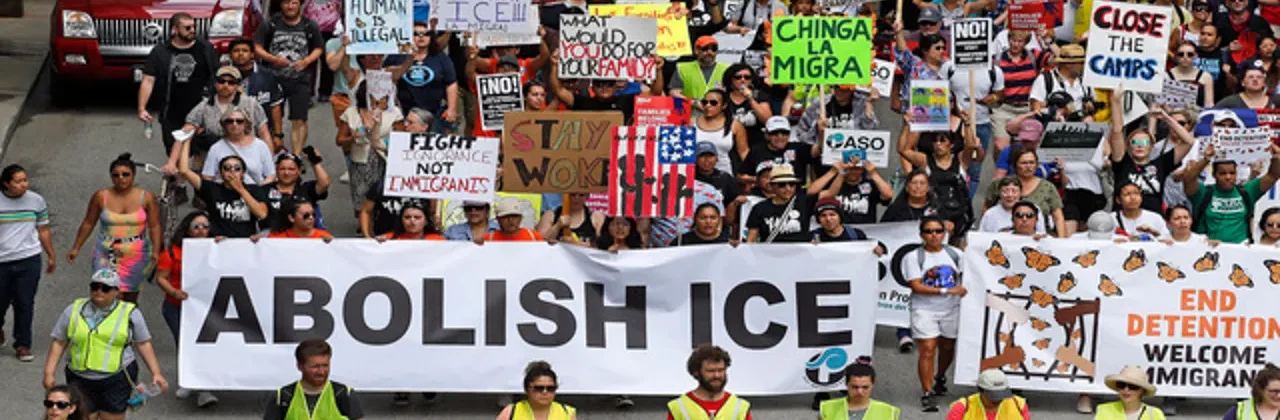
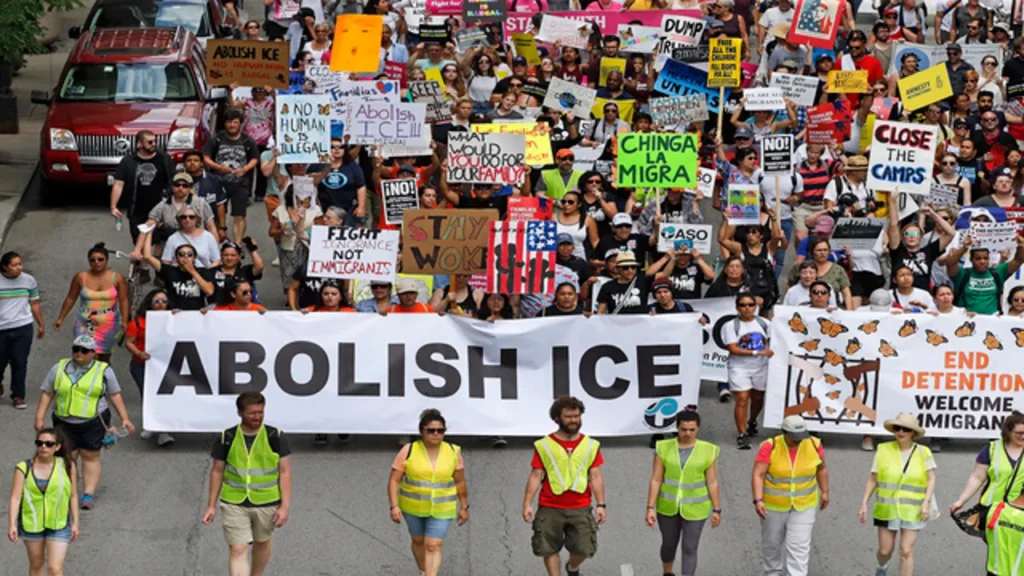
But demonstrations continue to take place under the slogan ‘Chinga la migra!’, which means ‘Fuck ICE’. After Renée Good was shot on the 7th of January, the protests intensified. On the 8th of January, 10,000 people took to the streets. Six prosecutors resigned because the US Department of Justice wanted to force them to launch a police investigation against Good’s widow. At the end of January, the FBI agent who investigated Ross resigned after the Department of Justice demanded that she drop the investigation.
‘ICE out!’ The day of action on the 23rd of January
The day before the day of action, JD Vance had come to Minnesota especially for this purpose. In a press conference, he blamed the local authorities and the Democrats. Because they did not cooperate with ICE, he said, things had gotten ‘out of control.’ By this he probably means that ICE and CBP can no longer take a step without being disturbed.
The 23rd of January was the biggest day of protest so far. Hundreds of shops remained closed, employees stayed away from work, and students and pupils stayed away from school. With temperatures as low as minus 25 degrees Celsius, more than 50,000 people took to the streets. The four demands: ICE out of Minnesota (‘ICE out!’); charges against Jonathan Ross; no additional money for ICE; companies should no longer do business with ICE. Many small business owners closed their shops, some served only food in support, and many in the education and health sectors went on de facto strike. Religious leaders and supporters attempted to block the airport which ICE and CBP use to deport people. In the run-up to the protest, some voices called for a general strike, but most trade unions prevented this because they adhere to existing collective agreements that prohibit strikes. There is no evidence or figures yet on mass sick leave. Some institutions have announced that they will waive sanctions if people stay away from work. Solidarity demonstrations took place in New York, among other places; Payday Report counted 300 solidarity actions across the United States.
What was special about this day of protest was that it was almost exclusively supported by ‘documented’ individuals. For their own protection, undocumented individuals remained at home. Local authorities have introduced virtual lessons for vulnerable pupils (half of Spanish-speaking children and a quarter of students with Somali roots are currently not attending classes). Even UN Human Rights Commissioner Volker Türk said on that day that he was ‘dismayed by the now daily mistreatment and degradation of migrants and refugees’ in the USA.
The next day, CBP officers executed a second person: Alex Jeffrey Pretti, a 37-year-old intensive care nurse at a hospital for veterans, US citizens and city residents. Pretti was filming an ICE operation; when the cops knocked a woman down, he stepped in between them. At least six officers pinned him to the ground, beat him and fired ten (!) shots at him. Then came the usual bullshit from the government and DHS: the officers had to defend themselves, Alex was about to commit a ‘massacre of the officers,’ he was a ‘domestic terrorist.’, which is how they had described Renée Nicole Good, as well. Alex was a legal gun owner and apparently had a gun with him. But he wasn’t holding a gun in his hand, he was holding his smartphone. As early as June 2025, a paper was circulated within the Department of Homeland Security criminalising the filming of ICE officers as an ‘illegal tactic of civil disobedience’.
Attorney General Pam Bondi wrote a letter to Governor Walz on the same day, saying that his “rhetoric” was promoting “lawlessness on the streets”. She demands that Walz hand over all documents relating to the federal programmes (Medicaid, SNAP) affected by the above-mentioned fraud to the Department of Justice, that the Minnesota police cooperate with ICE, and that the Minnesota voter registry be handed over. (In early January, Trump claimed that the elections in Minnesota were rigged and that he had done ‘greatly’ there.)
Trump has now sent Tom Homan to Minnesota to lead the operations there. After Renée Good’s death, Homan had called for ‘further consistent action without apology.’
Civil war or class struggle?
Hundreds of people quickly gathered at the scene of the murder. Walz has now called in the National Guard to de-escalate the situation. National Guard soldiers are to wear neon vests so that they can be distinguished from ICE/CBP. This further militarises the conflict.
In armed street fighting, ‘civil society’ doesn’t stand a chance. It looks like Trump, who’s under massive pressure on many fronts, is banking on armed conflicts escalating into a civil war scenario. After the 23rd of January, ICE wants to be able to raid homes without a search warrant – until now, people have been safe in their homes. Now the primary task is to confront the right-wing extremist shock troops en masse and defend the ‘sanctuary cities.’ Residents are preparing for a tough fight. According to information from hotel employees, ICE has booked rooms until the end of June 2026.
As after the murder of George Floyd, many people have become newly politicised and want to ‘get involved’; they show incredible acts of solidarity. Leftists are discussing what they need to do better after the experiences of 2020, what forms of organisation can make the protests stronger. The emerging self-organised infrastructure of networked initiatives will play an important role.
Would undocumented workers have the power not only to stop the ICE raids, but even to challenge the Trump administration? A ‘general strike’ by all undocumented workers is probably a utopian dream, but even a significant proportion of them could paralyse many sectors and confront those fellow workers who have citizen status with the intolerable conditions that the undocumented have to deal with. In an escalated situation, many would have to decide which fate they share: duck away or fight together? The advantage at the moment is that many of the Hispanics who voted for Trump are turning away from him.
Organising in these areas is difficult. In the harsh winter, there is no work in the fields or on construction sites. But migrant hotel employees could refuse to accommodate ICE officials. Employees of car rental companies, where ICE thugs pick up their neutral SUVs, could refuse to give them the keys. These suggestions are not fictional; initial attempts have been made and they are being discussed.23 Blockading important transport infrastructure such as the airport could build pressure. The Minneapolis-St. Paul region is also an important hub for parcel and rail logistics. Trump’s thugs do not care about law and order; they use the state terrorist methods of narco-states and military dictatorships. People must find their way in this situation and come up with new answers.
Stopping Trump will require more than neighbourhood mobilisations and a courageous civil society. Many called the combination of street protests, blockades and walkouts on the 23rd of January a ‘21st century general strike’.24 But without extending the strikes to large businesses, transport and warehouse logistics, Trump’s troops cannot be stopped.
Part of the class is threatened with deportation and death, and supporters are to be deterred with executions. Trade unions are likely to find it difficult to maintain industrial peace – initial meetings to organise genuine work stoppages across the US are now taking place.
The Minnesota Post has current pictures of the protest
The Guardian on US-wide protests
—————————–
Footnotes:
[1] Centre for Migration Studies, 27 August 2025
[2] Economic Research Service of the Department of Agriculture, 18 November 2025
[3] Janika Kuge: Bleiberecht jenseits des Nationalstaats: Kämpfe um Sanctuary Policy in den USA (Right of residence beyond the nation state: struggles over sanctuary policy in the USA), Westfälisches Dampfboot 2025, p. 22ff.
[4] Project 2025 (p. 174 in the PDF)
[5] Economic Policy Institute, 10 July 2025
[6] The New Republic, 19 August 2025
[7] The Atlantic, 5 August 2025
[8] Jeff Tischauser, SPL Center, 7 February 2025
[9] Joseph Cox, 8 January 2026 on 404media
[10] NBC News, 22 October 2025
[11] Washington Times, 21 June 2022.
[12] Michael Macher, Enforcement Regime – Immigration hardliners in the US state, 9 January 2026
[13] Ken Klippenstein, 14 January 2026
[14] Die Zeit, 19 October 2025
[15] The American Prospect, 22 October 2022
[19] The Intercept, 31 December 2025.
[20] YouTube https://www.youtube.com/watch?v=CRwbQItxdn8, https://www.youtube.com/shorts/K731QsJrlr8, https://www.instagram.com/reel/DTUJ0QKk-1J
[21] Labor Notes, 1/2026.
[22] On the 10th of July 2025, farmworker Jaime Alanís Garcia fell to his death while fleeing ICE agents during a raid in California; on the 14th of August, day labourer and trade unionist Roberto Carlos Montoya Valdez was run over by an SUV as he fled from ICE officers who were raiding a Home Depot store in Southern California. On the 12th of September 2025, ICE officers shot and killed Silverio Villegas González during a traffic stop in Chicago. On the 23rd of October, gardener Josué Castro Rivera was run over by a truck in Virginia as he attempted to flee during an ICE traffic stop. In mid-January 2026, an autopsy revealed that Cuban Geraldo Lunas Campos did not die by suicide on the 3rd of January in the largest deportation prison in El Paso, as claimed by the DHS, but by murder.