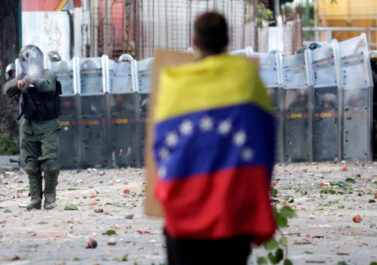
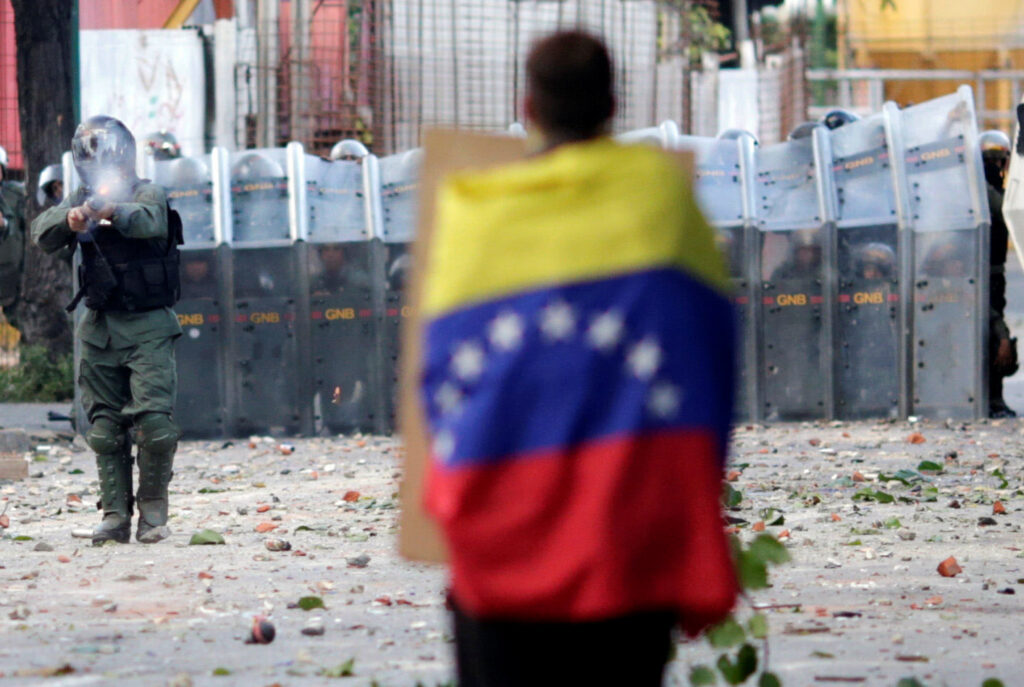
The attacks of the US army in Venezuela are an expression of imperialism, but how can we respond to them? Understandably, the reaction of many people is to rally for ‘national independence’. From a working class perspective and the perspective of international emancipation, the battle cry for ‘sovereignty’ is a dangerous myth. The situation in Venezuela is part of a global panorama of block confrontation and as international workers we have to find ways not to get crushed in the middle.
Venezuela and China
One of the reasons given by the US government for fighting ‘communism’ in Venezuela is its close ties to ‘enemies of the US’: China and Iran. On the evening before his abduction, Maduro received a high-ranking Chinese delegation. Shortly after the meeting ended, he was sitting in a US army helicopter. China is now effectively the only relevant factor countering the current march of the US and US-aligned movements in Latin America (Milei/Argentina, Bukele/El Salvador, Nasrallah/Honduras, Kast/Chile, Mulino/Panama, etc.).
China currently imports approximately 80% of Venezuela’s daily oil production of 950,000 barrels per day (as of November 2025, i.e. before the first tanker was seized by US troops). There is no data whatsoever on the actual prices at which China has been buying Venezuelan oil over the last 10 years or at which the ‘enormous collection of goods’ delivered from China to Venezuela on credit (house hold appliances from Haier, Yutong buses, cars) is being charged. Even a factory for assembling Yutong buses was set up in Yaracuy in 2015.
In Chancay, Peru, the Chinese logistics giant COSCO operates a large deep-sea port 100 km north of the capital Lima. From there, the voyage to China takes 23 days, down from 40 days previously. In Panama, the US wants to oust China from the two ports at either end of the canal (Colón and Balboa). Meanwhile, Black Rock/MSC and COSCO are fighting over the shares. Panama has left the Chinese supply-chain project ‘Silk Road’ again.
It appears that there are no US troops in Venezuela, at least not in any significant numbers. When Trump announces that the US will now govern the country until an ‘orderly transition’ takes place, this can only be based on the threat (made real by the kidnapping of Maduro) that they could strike effectively and deadly anytime, anywhere.
The war in Ukraine and the genocide in Palestine are part of this picture
We can see the outcome of the alleged struggle for ‘national independence’ in Ukraine: working class people from both sides are sent into the meat grinder. The Russian government needs the war to maintain its power and becomes increasingly dependent on supplies from China and Iran. The Ukrainian government depends absolutely on EU and US military and financial support and sells agricultural land and infrastructure to western companies in return. Instead of ‘defending democracy’ the Ukrainian state curbs trade union and political rights and forcefully conscripts young men to the front line. ‘Leftists’, like the Green Party in Germany, but also groups closer to home, repeat the myth of ‘national self-defence’ in order to demand more and more weapons for the massacre.
Even the genocide in Palestine cannot be understood outside the picture of block confrontation. It was no coincidence that the confrontation escalated shortly after the Chinese government managed to bring the Saudi Arabian and Iranian government to the negotiating table. It was clear that this was undermining the earlier Abraham Accords that had been brokered by the US and that the regional power-balances would shift drastically. At this point, everyone who had a stake in the game wanted to exert their influence. The territory of Palestine is used as a minor chip in the bargain, in particular by the regime in Iran, which is the main sponsor of Hamas. On the other side the west and the US bolster the Israeli war machine. While tens of thousands of richer Palestinians were able to flee the region, the local proletarian population in Gaza pays the price.
We can see that the idea of ‘national independence’ in a global capitalist world is a myth. The problem is that the counterpart to the US block – meaning, states like China, Iran, Russia – also has nothing to offer in terms of workers’ liberation. While we see Iranian flags being waved at protests against the war in Gaza, in Iran itself thousands of working class people currently clash with the state forces, protesting against inflation and the regime. Which side are we on?
Working class resistance against the drive to war
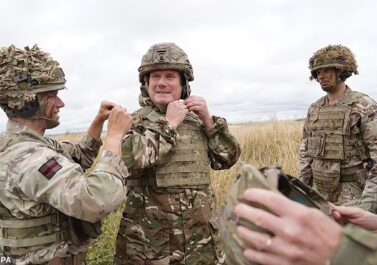
We currently witness a global arms race, led by the US, which will spend over a trillion US-Dollar on military defence in 2026. The EU plans a military budget of over 2 trillion Euro for the coming seven years. It is clear that they pay for this by cutting our income and welfare, such as health and education. Every government wants to normalise this preparation for future wars, in the UK we are repeatedly told that we are at war with Russia.
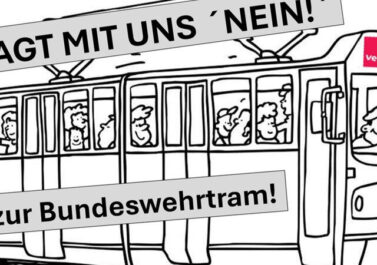
We have to refuse this in our day to day struggle. We have to develop a wider strategy on how to sabotage the war machine, how to defend ourselves against state aggression, such as the attacks on migrants by ICE units. We need strategies of underground proletarian resistance, combined with struggles where we have larger collective power. Workers at ST Microelectronics in France went on strike against the use of their product for the military, tram drivers in Munich refused to drive trams with army recruitment advertisement, dock workers in Genoa block ships with weapon deliveries and call for general strike, school students in Germany protest against the state effort to reintroduce army conscription, health workers demonstrate against plans to draft them into the military medical apparatus, DHL workers protest against the involvement of their company in military logistics, VW workers denounce the companies plan to sell parts of the plants to the weapon industry.
All these small struggles are expressions of the question of worker control: who decides what happens with the things that we produce or the services that we provide? We have to gradually expand this battle over control to the social level. Against global war, for a free and communist future.