We translated this article by comrades from France, as we think that it has international relevance. The global steel industry is at the centre of trade wars and, related to this, the process of militarisation. With the downturn of the automobile industry we see a global overproduction of steel. The US and the EU react by putting up tariffs, which squeezes the steel industry in the UK.
In reaction to the blackmail from steel companies, the Labour government promises further subsidies with their £2.5 billion ‘steel fund’. In times of general preparation for larger wars, steel production becomes a national security asset. When the Chinese steel manufacturer Jingye announced the closure of the blast furnaces at the Scunthorpe site in April 2025, the UK government stepped in and semi-nationalised the plant. As you can read in the article below, nationalisation has little to offer for the workers on the ground.
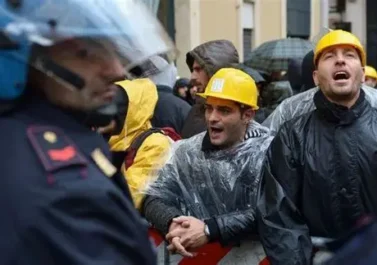
Given this global picture it is not a coincidence that things are kicking off elsewhere. In November and December 2025, steel workers in Genoa occupied squares, blockaded motorways to the airport and used heavy forklifts during confrontations with the police. Steel workers in the region also went on a general strike against the threat of 6,000 job cuts.
We are at a watershed moment. The threat of mass redundancies on one side and the promise to save jobs by vamping up arms manufacturing on the other. It is good to see that the steel workers’ protests in Genoa are happening in the wake of large anti-war strikes and blockades in Italy and in proximity to the most serious effort to defend factory jobs under worker control by the ex-GKN workers. These are the necessary components for a wider class movement against the crisis.
——————–
Since the Arcelor group’s management announced a new redundancy plan last April, strikes have been on the rise at the Dunkirk site. In the background, the vested interests of industrialists from various sectors and local decision-makers are intertwined.
From Usinor to Arcelor
Usinor was founded in Dunkirk in 1962 and immediately established itself as one of the largest steelworks in the region. The plant covered an area of 25 km2 and employed up to 11,400 people in the mid-1970s. At that time, workers were recruited from no fewer than 200 surrounding municipalities, some of them former miners who had retrained, others steelworkers who had been displaced from eastern regions. Industrial restructuring was already beginning to have an impact. However, this gigantic recruitment did not mean that the workforce was concentrated in one place, as in other sectors such as the automotive industry. Usinor was spread across several separate sites, far apart from each other. Today, after decades of production concentration, only 3,500 direct jobs and a thousand subcontractors remain in the factory.
Lobbying and public money
Arcelor has 40 production sites in France, where it employs some 15,000 people. In May 2025, the group’s management announced the elimination of 600 jobs, mainly in Dunkirk and Florange, as well as the closure of its small factories in Reims and Denain (1). The employers’ argument, invariably the same, cites: ‘unfair competition (2), weak demand and high production costs’. Admittedly, demand for steel has fallen by 20% in France over the last five years, and the sector is facing a global crisis of overproduction (3). But over time, the steel barons, whether from Lorraine or India, were able to use their wailing about the crisis to gorge themselves on billions in public subsidy money, using their networks of influence and the blackmail of possible job cuts in turn.
Alarmed that ‘the steel industry in Europe is in crisis’ and that ‘all sites are at risk’, the president of Arcelor France has been calling for EU protection and higher customs barriers. In the meantime, the group is freezing its investments in CO2 emission reduction, particularly at its Fos and Dunkirk sites. This decision seems incomprehensible at first glance, given that he also complains that CO2 adds 10% to the selling price of his steel.
In reality, it is a godsend for the employers and a question of timing (4). With its France 2030 plan, the government has announced that it will mobilise €4.5 billion for the decarbonisation of industry and is preparing to provide €13.6 million in aid to the Dunkirk industrial port area, which ranks second among the areas with the highest greenhouse gas emissions. Once again, for the steel bosses it will be a matter of waiting and seeing how to benefit the most…
Decarbonisation, electrification, mystification
For both the steelmaker and the CGT trade union, decarbonisation must first involve the electrification of production. The idea seems obvious, especially since the Gravelines nuclear power plant is located a stone’s throw from the steel complex. Arcelor has been relentless in its contradictory announcements on the subject, using misleading communication. Hoping to reassure both the public authorities and its employees, the group simultaneously announced a major redundancy plan and a €1.7 billion investment in the construction of electric furnaces. In the end, the manufacturer scaled back its plans and changed course, with the electrification of production no longer on the agenda. At the Mardyck site, a stone’s throw from Dunkirk, only €500 million will be invested, not in electric furnaces as previously announced, but in three production lines for ‘electrical steel’, obtained from recycled scrap metal and intended for the production of car engines.
Nuclear power in an era of rising sea levels
Let us pause for a moment to consider the implications of replacing coal with electricity in the steel manufacturing process. As we have written, the Gravelines nuclear power plant is seen as an essential player in this conversion. It is the asset of the ‘ecological transition’ of the Dunkirk industrial basin and is the focus of much attention, especially since the recent installation of new energy-intensive industries such as gigafactories (5).
Commissioned in 1974, the Gravelines power plant is one of those whose lifespan has been repeatedly extended beyond the standards established at the time of construction. Two EPR 2 reactors are set to replace the ageing structure by 2040, but the project faces significant constraints. For example, the density of EPR reactors is twice that of the facility currently in operation, meaning, they are much heavier and put more strain on the ground. The mechanical characteristics of the soil located on the coast are considered poor by the ASNR, as a substantial layer of it is too mobile (6). In addition, the risks of submersion and soil liquefaction are now proven due to the effect of coastal retreat and sea level rise…
‘A spontaneous strike’
It was in this context that, in early December, a spontaneous strike movement took both the company’s management and the CGT trade union by surprise. According to the latter, the plant was operating at only 30% of its capacity and a blast furnace had been shut down. It should be noted that this movement arose in the very official context of the NAO, the obligatory annual negotiations between employer and unions, which were then suspended. The mobilisation is said to have originated in sectors of the factory that were not usually involved in industrial action. The demands themselves were very traditional: higher wages, bonuses, improved working conditions, hygiene, etc.
This was enough for the CGT representative to declare this episode ‘historic, unprecedented.’(7) According to him, we are “in an insurrectionary situation (…) given how the movement started, it is beyond our control (…) certain departments that had never gone on strike are now mobilising, and these are not CGT strongholds. As for management, it cites ‘the seriousness of the economic situation’ and “invites” workers to ‘return to work as soon as possible.’
In this case, it would appear that resistance to restructuring has become mixed up with more immediate demands. The announcement of a new redundancy plan in a context of attacks on wages and deteriorating working conditions may have encouraged the grassroots initiative. But in the game of bluff poker being played by both the group’s bosses and the trade unionists, there is no indication of the path the strikers will take in the coming days, and they themselves are probably unaware of it: is this a sudden outburst of anger or a broader aspiration to go beyond a certain framework? (8) In this context, the CGT’s heated statements seem like an invitation to management at a time when the National Assembly is once again voting on the nationalisation of the site.
In any case, this struggle is part of a new cycle of company closures that employers are vigorously pursuing, and it is in this context that the balance of power at stake must be assessed.
When nationalisation resurfaces
The nationalisation of Arcelor Mittal is a demand that has been made in Dunkirk by the CGT for over a year and relayed in a pre-election context by the parliamentary left-wing parties, led by La France Insoumise (LFI). It resurfaces with every restructuring, but this time, MPs adopted it at first reading on Thursday, the 27th of November 2025. However, there is little chance that the text will pass the Senate, where the right and centre have a majority.
In the early 1970s, the nationalisation of key sectors was included in the ‘Common Government Programme’ drawn up at the time by the PS and the PCF. At the end of the decade, with ‘the steel crisis’, it became the battle cry of the CGT at Usinor, whose slogan was “There is only one solution: nationalisation. “ It did indeed take place once the left came to power. At the time, the SLT (Syndicat de Lutte des Travailleurs d’Usinor-Dunkerque) (9), created on the initiative of activists who had left the CGT and a number of others who had been ousted from the CFDT, which was then in the process of refocusing, set limits on it and stated: ‘nationalisation does not necessarily offer prospects for struggle.’(10) At present, in a period of decline, nationalisation seems to some to offer a guarantee in the face of a more than uncertain future.
Nationalisation and its lessons
Let us return to an episode that occurred within the newly nationalised company. On the 4th of June 1982, a piece of steel struck five workers operating a continuous casting machine in steelworks number 2. Two of them died, one an hour after the accident, the other five days later. Immediately, a power struggle ensued between the SLT and Usinor’s management. The union pointed to the latter’s full responsibility for the deaths of the two workers. The factory hierarchy responded by orchestrating a set-up against a union representative, whom it suspended and then managed to dismiss, overruling the decision of the labour inspector (11). The left was in power at the time, having nationalised the factory, and as usual, it sided with order and ruling class justice.
On the 26th of February 1983, Pierre Mauroy, challenged by SLT activists during a municipal council meeting at Lille Town Hall, praised “the struggle of the Usinor workers. ‘ On the left, there was much talk of ’new citizenship in the workplace”; it was the era of the Auroux laws… But never mind, at the same time, the Prime Minister’s office ruled in favour of the bosses. In a letter addressed to the SLT, it decided that: ‘The government respects the management autonomy of nationalised companies and has no intention of intervening in social relations within these companies.’ Social relations in the workplace are precisely what the left will never tackle, nationalisation or not!
In May 1977, activists from the Usinor Communist Party organised a referendum in favour of nationalisation at the site’s exit. One of them understood this, musing that: “Even if we manage to get rid of the steel industry bosses, the managers and supervisors will still be there… “
Boulogne-sur-Mer, 18/12/2025
———————-
Footnotes
(1)The redundancy plan was approved by the State on the 17th of December. 608 jobs are being cut, including 84 in Dunkirk and 4 in Mardyck.
(2)‘Unfair competition’, a perfect truism.
(3) According to the OECD, steel overproduction is expected to reach 721 million tonnes by 2027. China remains the world’s leading producer with 1,882.6 million tonnes in 2024, compared with 130 million for the EU and 11 million for France.
(4) The amount of public aid received by Arcelor is impressive and difficult to establish precisely: €392 million in state aid since 2013, according to one survey; €192 million in tax credits; €100 million in aid to reduce electricity bills; preferential interest rate loans from the State and €4.5 million in aid from the Environment Agency; €56 million from the State and local authorities to modernise its facilities. On the EU side, aid paid since 2008 amounts to €4.7 billion. Finally, between 2006 and 2021, through business operations, Arcelor has earned €3.2 billion from the resale of pollution allowances.
(5) In early December, the Vektor electric battery factory was inaugurated, the third such facility to be established after those in Billy-Berclau and Lambres-lez-Douai.
(6)The ASNR sets out its expectations regarding the ground reinforcement system required for the installation of EPR2 reactors at the Gravelines site: https://www.asnr.fr/actualites/lasnr-formule-ses-attentes-concernant-le-systeme-de-renforcement-du-sol-necessaire
(7) Contrary to what this delegate claims, this is not ‘unprecedented’. Usinor’s labour history was marked by spontaneous, wildcat strikes and hunger strikes during the 1970s and 1980s.
(8) For some time now, there has been a resurgence of grassroots initiatives, with wildcat strikes at the SNCF Technicentre in Châtillon and the national strike movement by ‘train commercial service’ agents.
(9) Brochure from the CFDT union section dissolved by the federation on 1 June 1979: ‘In the struggles, the creation of the CFDT Usinor-Dunkerque section: a fight we are continuing’. June 1979.
(10) About a public debate evening we organised with comrades from the SLT at the municipal library in Boulogne-sur-Mer: https://lamouetteenragee.noblogs.org/post/2011/10/05/au-pays-dusinor-la-projection-et-le-debat-autour-de-lexperience-du-syndicat-de-lutte-des-travailleurs-dusinor-dunkerque/
(11) SLT brochure from April 1983: At Usinor Dunkerque – a nationalised company – a scandalous and illegal dismissal.